Reserves of 195 trillion cubic feet, almost half the gas produced is flared or vented, and a new regime in Caracas is handing out licenses faster than at any time since the 2019 sanctions.
By Elio Ohep, Petroleumworld-EnergiesNet
SAN DIEGO, CA
Petroleumworld.com/EnergiesNet.com 08 19 2026
Editorial note: Petroleumworld-EnergiesNet has covered this story since 1999. Over these three decades we have sat through presentation after presentation on one project after another — Cristóbal Colón, Mariscal Sucre, Dragon, Loran, Deltana — each one making the same promise under a different name. It has been a long road, and it should finally reach its end: a final investment decision from the companies involved, and a firm work schedule, both for the offshore gas and for the gas still being flared and vented onshore today. This time, the opening comes from the United States, through its political and financial backing. It should not be wasted.
The gap between what Venezuela has and what it uses
Venezuela holds, according to the U.S. Energy Information Administration (EIA), 195 trillion cubic feet (Tcf) of proven natural gas reserves — 73% of all of South America’s total. Other estimates used in the industry, like the ones from the consulting firm Brattle, put the number closer to 5,500 BCM (the seventh-largest in the world). Either way, it’s by far the biggest gas reserve in the region.
And yet, according to that same Brattle report and data from Global Witness, production dropped from 7.4 billion cubic feet a day (Bcf/d) in 2013 to just 3.9 Bcf/d in 2024. Of that, almost half — 46%, per Global Witness and the Energy Analytics Institute — is burned off because there’s no infrastructure to capture it. Another 8% is vented straight into the air. The World Bank and Global Witness both rank Venezuela among the four or five biggest gas flarers and venters in the world, with about 8.3 billion cubic meters burned off in 2024 alone.
That gap — huge reserves, almost nothing turned into revenue — is where everything happening in the sector this year starts.
The new political picture
A lot is happening in 2026: U.S. forces captured Nicolás Maduro on January 3 (NPR); D. Rodríguez took over the interim regime, in what analysts at the Congressional Research Service call “normalization without transition”; and Washington now directly controls part of Venezuela’s oil money — more than $13 billion sitting in Treasury-controlled accounts as of July, according to the Kleinman Center for Energy Policy at the University of Pennsylvania.
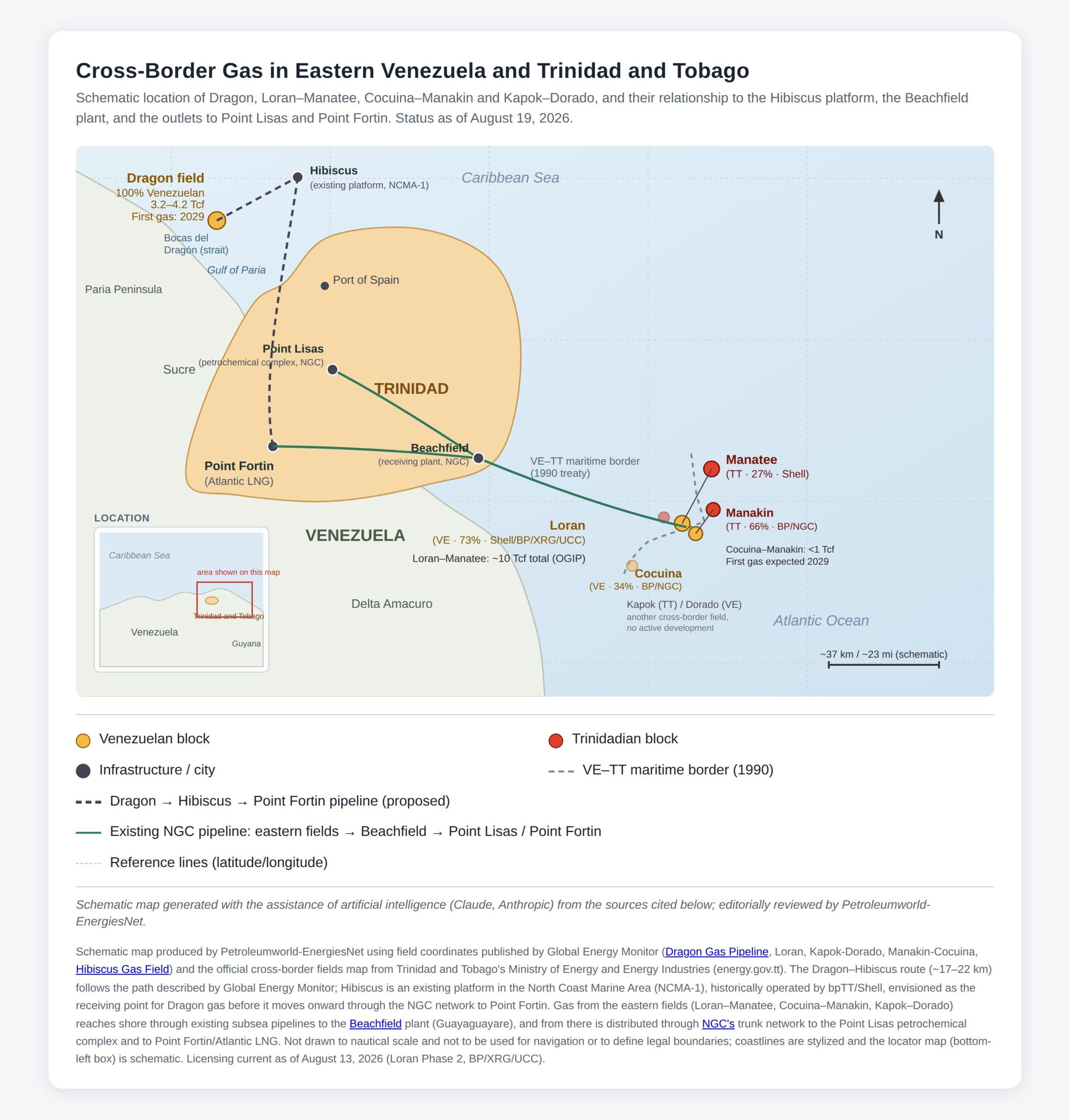
On top of that, a new Hydrocarbons Law, made easier for investors in July 2026, aims to bring in $100 billion over ten years, and ExxonMobil and ConocoPhillips are back at the table after more than twenty years away (both facts per the CRS). Against that backdrop, two offshore projects are getting most of the industry’s attention: the Dragon field, and the Loran-Manatee block on the Plataforma Deltana — both sitting right on the sea border with Trinidad and Tobago.
Dragon: four decades of trying
The Dragon field was found in 1985, as part of the Mariscal Sucre Project, according to Global Energy Monitor. Since then it’s been through round after round of studies, memorandums of understanding, and announcements of a “next step” — without ever reaching a final investment decision, or laying a single pipe. Miguel Ramón Rivas, who worked at PDVSA-Bariven in 1991, says — in a comment on María Alejandra Cabeza Rodríguez’s LinkedIn post — that back then the project was called Cristóbal Colón, and that poor management was already holding it back thirty-five years ago.
Something similar happened with the neighboring Loran-Manatee field, also found in 1983: Venezuela and Trinidad combined it into one project in 2010, then split it back apart in 2019 so Shell could develop the Trinidad side, Manatee, on its own. That’s how Kevin Ramnarine, Trinidad and Tobago’s former energy minister, tells the story in a LinkedIn post. The whole field is now thought to hold about 10 Tcf of gas in the ground (OGIP), split 73% for Loran, on the Venezuelan side, and 27% for Manatee, on the Trinidad side, according to a chart from energyandlaw.com that goes with that post.
In our view, it would make more sense to combine Loran-Manatee back into one project, the way Cocuina-Manakin was combined in 2015. It’s the same gas deposit, cut by a border, with Shell running both sides — building it as one project would avoid building two sets of platforms, pipelines and studies where, technically, only one is needed. The 2019 split happened because of the political pressure of the moment — Trinidad needed to move ahead with Manatee while Venezuela was still under full sanctions — not because it made better engineering sense.
What’s new in 2024-2026 is that, for the first time, there’s a real 30-year license, shared by Shell and Trinidad’s state gas company NGC, to develop Dragon and connect it, through a pipeline under the sea, to the Atlantic LNG plant at Point Fortin. Trinidad got its first license from the U.S. Treasury in 2023; Washington took it away in April 2025, as part of a wider push against Caracas; and after Trinidad complained — it badly needs gas to keep Atlantic LNG running — Washington gave it a six-month temporary license in October 2025, the first of three planned steps, which requires bringing in a U.S. company for the development phase. That step runs out in April 2026 (timeline from Enerdata).
When the license was pulled in April 2025, Venezuelan economist Francisco Monaldi, of Rice University, put it plainly in comments to Gas Outlook: “the gas plan is now postponed, if not dead.” But he added it could come back “under certain conditions,” like a policy change in Washington, or a regime change in Venezuela. Ten months later, the second one happened. Luisa Palacios, of Columbia University’s Center for Global Energy Policy, was just as blunt about the real problem in that same piece: “Venezuela failed to monetize its natural gas resources, both on the western side and now on the eastern side. This is bad for Venezuela and bad for Trinidad.”
Maduro’s capture didn’t clear things up — it added a new layer of doubt. According to ICIS, Trinidad’s access to Dragon “remains unclear” after the U.S. military action, and Prime Minister Kamla Persad-Bissessar said the gas “is the property of the Venezuelan people,” and that a future elected government will decide what happens to it. That same ICIS report is also where the idea comes from that the gas could just as easily go to Colombia, or to future Venezuelan LNG plants — right as the world LNG market is heading toward too much supply. In February, Shell’s CEO, Wael Sawan, said — per EnergyNow — that the company wants to start pulling gas from Dragon within three years, with a final investment decision possible “within months.” The 3.2-to-4.2 Tcf figure for Dragon, and the 2029 first-gas date, come from the energyandlaw.com chart already mentioned, and roughly match what Sawan said.
The skeptical view from Port of Spain
Kevin Ramnarine, Trinidad and Tobago’s energy minister from 2011 to 2015, is the most cautious voice on the Trinidad side. Back in 2023, when Port of Spain got its first Treasury license to talk about Dragon, he warned — per the Trinidad Guardian — that sanctions “do not derail the deal, but they make it a lot more difficult for Shell to implement” in a heavily sanctioned Venezuela.
In 2025, after Washington made a move against Chevron’s Venezuelan operations, he went further: per the Trinidad Express, he warned that this “could set a precedent for what T&T may face” in its own cross-border deals, and asked why gas cooperation seen as good in 2013 would stop being good in 2025 just because Washington’s mood changed.
His bigger-picture point, also reported by the Trinidad Guardian, is that Trinidad doesn’t need Venezuela. With the Coconut, Ginger and Cypre projects, ExxonMobil’s deep-water acreage, and the Manatee field on its own side of the border, he says the country “still has, within its own geography, significant reserves of natural gas which we have yet to discover,” and could keep its LNG industry running without Venezuelan gas by 2027 if it decides to “double down” on developing its own fields. It’s a good reminder: the urgency felt in Caracas isn’t always felt the same way in Port of Spain.
Rystad Energy backs up some of that confidence. Schreiner Parker, the firm’s managing director for Latin America, told Gas Outlook that losing the license in 2025 was “maybe not as catastrophic as it would have been last year or the year before,” thanks to progress on Trinidad’s own projects, like Manatee (Shell’s, already on the Trinidad side) and Calypso (Woodside’s). Rystad expects Trinidad’s own gas production to climb back up to 3.7 billion cubic feet a day by 2030, from 2.53 Bcf/d in 2024 — a home-grown supply that, by this reading, makes any deal with Caracas less urgent for Port of Spain.
Deltana and BP: the newest news
While Dragon stays stuck in talks, the Plataforma Deltana produced the sector’s freshest development. On August 13, 2026, BP, along with XRG (the investment arm of Abu Dhabi’s ADNOC) and UCC Oil and Gas Holding, was awarded the license for Loran Phase 2 — after Shell had already gotten an earlier license on the same block — inside the cross-border Loran-Manatee reservoir, according to Offshore Energy and OilPrice.com. BP puts Phase 2’s recoverable gas at 4 Tcf, a piece of the 7.3 Tcf that belongs to Venezuela out of the reservoir’s 10 Tcf total; the three companies each hold an equal share of Phase 2, with BP running it. The deal followed an April 2026 agreement between BP and the Venezuelan regime, which also covered the Carúpano East block (both details from the same sources). Since Shell and BP are also the top shareholders in Trinidad’s Atlantic LNG, Ramnarine points out in his LinkedIn post, Loran’s gas will likely end up going there anyway; any other option, he adds, would “certainly cost more.”
Fernando E., a strategic advisor who focuses on Venezuela’s transition, explained in a comment on the same LinkedIn post why this announcement feels different from the ones before it: “Loran is not a baseball game. It’s the first proof that Venezuela is negotiating gas from a position of strength, not emergency,” with “7.5 TCF crossing the border, Shell as operator, and a Hydrocarbons Law loosened up in July” as the package that “upstream investors have been waiting two decades for.” His closing line — “the window isn’t opening for Venezuela, it’s opening for whoever is ready when it does” — sums up the mood of the more upbeat commenters pretty well.
RamRei Energy Group — a small energy consulting firm started in 2018 by Reinaldo Ramírez, focused on subsurface work, not one of the big research houses in the industry — made a similar point, in another comment on the same post, calling it a paradox: “Venezuela has the resource, Trinidad has the infrastructure, and others get to capture the value.” That’s close, in spirit, to what Luisa Palacios (Columbia) said about Venezuela failing to cash in on its gas on both sides of the border: it’s the same mismatch that has kept Caracas, Port of Spain, London (Shell and BP), and now Abu Dhabi (XRG) all interested in each other, and it’s exactly what the new Hydrocarbons Law is trying to fix with better tax terms and international arbitration for investors.
Cocuina-Manakin: the project nobody talks about, and maybe the most important one
There’s a third cross-border gas deposit that almost never gets the same attention as Dragon and Loran, and Ramnarine himself, in a LinkedIn post (“The Historic Cocuina-Manakin Development”), thinks it could actually matter more than both of them, for one specific reason: Cocuina-Manakin.
The Venezuelan side, Cocuina, was found by PDVSA in 1983 — the same year as Loran-Manatee. The Trinidad side, Manakin, was found by BP/Amoco in 2000. The two countries signed a sea-border treaty in 1990, a framework agreement for combining cross-border gas fields in 2007, and finally combined Cocuina-Manakin into one project in 2015, agreeing to split it 66% for Manakin (Trinidad) and 34% for Cocuina (Venezuela).
It wasn’t a smooth path: the Venezuelan block (Block 4) went through Statoil in 2003, added Total as a non-operating partner in 2005, had a test well drilled in 2006, and went back to the Venezuelan government in 2021 when those partners walked away. In 2024, Venezuela gave a new 20-year license to BP and NGC to develop Cocuina; that same year, Repsol sold its 30% share of the Trinidad block (5B/Manakin) to BP, and in 2026 NGC itself bought another 20% of that same block.
Combined reserves are put at under 1 Tcf, with production expected to peak at 400 million cubic feet a day — about 16% of Trinidad and Tobago’s current gas output. BP hasn’t made a final investment decision yet, but Ramnarine wrote that “the probability that it will happen is now the highest it has ever been,” with first gas expected in 2029. What makes it stand out, he explains, is that — unlike Loran-Manatee, which was split back apart in 2019 so each country could develop its own side — Cocuina-Manakin, if it reaches production, “would represent the first jointly developed production of hydrocarbons from a unitized cross-border field in this part of the world.”
The gas being wasted onshore
There’s a fourth front that almost never gets the attention the three offshore projects do: the gas that comes up alongside Venezuela’s oil and gets burned or vented right at the wellhead, on land. According to the EIA, about 80% of the gas Venezuela produces comes up together with crude oil, and only about 30% of that gets pumped back underground to help pull out more oil; most of the rest just gets burned off.
Global Witness says Venezuelan crude is six times worse for methane leaks and ten times worse for flaring than the world average. If oil output climbs toward 3 million barrels a day — the target the new authorities have set — without fixing that infrastructure problem, the same report warns, combined emissions from flaring, venting and production could get close to 729 million tonnes of CO2 a year — about as much as the entire global shipping industry emits in a year.
Evanan Romero, an independent oil and energy professional, says he arrived in Caracas in 1957, fresh out of high school, to work at the petrochemical plant the government had just set up. He opened his comment on María Alejandra Cabeza Rodríguez’s LinkedIn post with that memory, and with the question that, he wrote, still hasn’t been answered after seventy years: “Will we use that gas to export raw material, or to build a reliable power grid and an industrial base that creates jobs and adds value?”
The real bottleneck isn’t the wellhead
Antonio Moreno, an engineer with maintenance and operations experience in the Monagas oil fields, left one of the most useful comments in the thread: the short-term priority, he said, is capturing flared gas, and that can be done “with low spending and more willpower” rather than new technology. The real quick-cash opportunity, he said, is the processing capacity Venezuela already built — and barely uses — at the Eastern cryogenic complex: about 2,000 million cubic feet a day of processing capacity, able to pull out 200,000 barrels a day of natural gas liquids, to supply the petrochemical plants at Jusepín, Santa Bárbara, San Joaquín and José.
Electrical engineer Juvencio M., in another comment on the same post, filled in the missing piece: those plants “have been there for more than 30 years,” but the problem isn’t the gas — it’s moving it. From Anaco, only 1,000 million cubic feet a day can currently be piped toward Altagracia de Orituco, and only about 40% of that — around 400 million cubic feet a day — actually reaches power plants: enough to run 1,700-1,800 MW of gas turbines, out of an installed base of more than 7,000 MW. That’s why, he added, the announcement that PDVSA Gas will deliver 2,000 million cubic feet a day to the domestic market in December is really “an admission of failure”: that number doesn’t even hit the maximum possible of 2,500 million cubic feet a day, and the real extra power it buys works out to only about 860 MW, against a rationing gap of nearly 4,000 MW. His conclusion: “this is an energy crisis, not just an electricity crisis.”
What if the offshore gas came onshore instead?
The same Evanan Romero, in another comment, warned about a different temptation: bringing onshore the gas that’s already committed to offshore exports (Dragon, Loran, Deltana). Doing that, he wrote, would mean “losing not just the value of the gas but a massive investment,” and he pointed out that the Chávez and Maduro regime itself “tried for 27 years to do exactly that” and never pulled it off.
Worth being clear here: that’s a different issue from capturing the gas that’s already onshore, tied to oil production, which is what Moreno and Juvencio M. are talking about. Mixing up those two things is one of the most common mistakes in this whole debate.
How to protect the money
Carlos Acosta P., a process engineer and industrial-plant designer, suggested in the same thread that gas from different places should go to different uses, based on cost: offshore gas is for export — it costs a lot to build, so it only makes sense at international prices — while fixing up the Caroní hydro dams costs between $15 and $30 per megawatt-hour, versus $65-95 for offshore gas, and onshore flared gas is “a much better deal” for local power plants.
His idea: export the gas from North of Paria to raise money for infrastructure, while the power grid gets fixed using hydropower and onshore associated gas. To protect that money, he suggested setting up an international trust fund — royalties from exports would go straight into an account run by an outside party (like CAF or the IDB), payments would only go out once audited work milestones were met, and the export revenue would back green bonds used only for the power grid.
The cautious voices
Not everyone shares the excitement about how fast the offshore gas will move, or where it will end up. Ruben Perez, director of the consulting firm ChemStrategy, was the most blunt in a comment on the same post: “Plataforma Deltana’s volumes will definitely not touch Venezuelan mainland.” The benefit for Venezuelans, he argues, will come through taxes and royalties — not through the gas itself. His advice: improve the terms on the onshore gas licenses that already exist, and finally learn to manage associated gas, which Venezuela has spent “more than 100 years undervaluing.”
José Reinaldo Sánchez Mistage, a geophysicist who specializes in oil and gas reservoirs, added a warning about timing: under today’s tax terms, he said, Venezuela risks “losing by forfeit” to up-and-coming deep-water competitors like Brazil and Guyana.
| Project | Location | Reserves / volume (OGIP) | Partners | Status as of August 2026 | Main source |
|---|---|---|---|---|---|
| Dragon | Offshore, 100% Venezuelan (Mariscal Sucre) | 3.2–4.2 Tcf | Shell, NGC | Negotiation license runs through April 2026; first gas expected 2029 | energyandlaw.com chart |
| Loran (Venezuela) / Manatee (Trinidad) | Offshore, cross-border | ~10 Tcf total; 73% Loran, 27% Manatee | Loran: Shell, BP, XRG, UCC. Manatee: Shell | Loran Phase 2 licensed to BP/XRG/UCC on August 13, 2026; Manatee first gas expected 2027 | Offshore Energy, OilPrice.com, Ramnarine (LinkedIn) |
| Cocuina (Venezuela) / Manakin (Trinidad) | Offshore, cross-border, combined into one project since 2015 | <1 Tcf total; 34% Cocuina, 66% Manakin | BP (80%), NGC (20%) on both sides | 20-year license on Cocuina since 2024; BP hasn’t made a final investment decision yet; first gas expected 2029 | Ramnarine (LinkedIn) |
| Onshore associated gas | Onshore oil fields (Monagas, Anzoátegui) | 46% of 3.9 Bcf/d is burned off; 8% is vented; Eastern cryogenic complex has ~2,000 MMcf/d of unused capacity | PDVSA / PDVSA Gas | No large project announced to capture the gas or expand pipeline capacity | Global Witness, EAI (flaring); Antonio Moreno, LinkedIn (cryogenic complex) |
Who’s in charge, and under what rules
None of these four fronts can be understood apart from the political change. In eight months, D. Rodríguez’s regime pulled off something Maduro’s regimes never managed in years: active licenses for Chevron, Shell and BP — and probably soon ExxonMobil and ConocoPhillips — all operating or negotiating at the same time. But Trinidad’s own prime minister has said plainly that a lot of these decisions will stay on hold until Venezuela has a government chosen in free elections (ICIS). On top of that, there’s Venezuela’s $170 billion in defaulted debt (Kleinman Center), and the fact that Washington — not Caracas — now controls where a lot of the oil money goes (EveryCRSReport, Kleinman Center).
José Gregorio Prieto, a consulting and project-management director, summed up some of the sector’s doubts in a comment on the same post, using a sports comparison: “in baseball you have to swap out the bad players for stars and build real teamwork. Here it’s the same team, and they’re still divided. This team can’t play in the major leagues.”
A window that’s never been open before
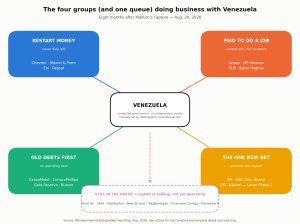
Venezuela used to have one path to cash in on its gas. Now it has four, all at once: Dragon toward Trinidad, Loran with BP and XRG, Cocuina-Manakin with BP and NGC, and the gas being wasted onshore every day. The first three depend on licenses from Washington and on final investment decisions that haven’t been made yet — and Ramnarine points out that Trinidad has its own backup options if those licenses fall through again. The fourth depends only on Venezuela deciding to invest in itself: building out the pipeline and compression capacity Juvencio M. describes, and restarting the Eastern cryogenic complex that Antonio Moreno sees as the country’s fastest path to cash.
Forty years of discoveries, memorandums and renewed licenses — from the 1991 Cristóbal Colón project to today’s Dragon, Loran and Cocuina-Manakin — never produced one exported molecule of gas, or a single plant that stopped the burning onshore. What exists now — U.S. money and backing, a Trinidad buyer that wants the deal (even if it has other options), companies holding active licenses on all four fronts, and even a trust-fund plan already proposed by people in the industry — is, in Ramnarine’s own words about Cocuina-Manakin, the moment when the odds of a final investment decision are “the highest it has ever been.”
This newsroom has covered every one of these announcements since 1999, and we’ve watched this window close more times than we can count. What’s different this time is the political and financial backing of the United States, with active licenses and money ready to move — something none of the earlier projects ever had. The question is no longer whether Venezuela’s gas can be turned into money. It’s whether, this time, Caracas, Port of Spain and Washington are actually willing to go from signing letters of intent to making a final investment decision and setting a construction schedule — offshore, with Dragon, Loran and Cocuina-Manakin, and onshore, with the gas that’s still burning today.
Sources: EIA; World Bank; Global Witness; Energy Analytics Institute; Brattle; ICIS; EnergyNow; Enerdata; Offshore Energy; OilPrice.com; EveryCRSReport (Congressional Research Service); Kleinman Center for Energy Policy (University of Pennsylvania); NPR; Global Energy Monitor; Trinidad Guardian; Trinidad Express; Gas Outlook (with on-the-record comments from Francisco Monaldi, Rice University; Luisa Palacios, Columbia University’s Center for Global Energy Policy; and Schreiner Parker, Rystad Energy); Kevin Ramnarine, “The Historic Cocuina-Manakin Development” (LinkedIn) and earlier LinkedIn posts; energyandlaw.com chart; and comments from Evanan Romero, Antonio Moreno, Juvencio M., Carlos Acosta P., Ruben Perez, José Reinaldo Sánchez Mistage, Fernando E., RamRei Energy Group, Miguel Ramón Rivas and José Gregorio Prieto on María Alejandra Cabeza Rodríguez’s LinkedIn post, AI Claude.
Elio Ohep, editor@petroleumworld.com
EnergiesNet.com 08 19 2026