


A reference guide to the size, structure, and risk of the deals signed since January 3, 2026
By Elio Ohep, Petroleumworld-EnergiesNet
SAN DIEGO, CA
Petroleumworld.com/EnergiesNet.com 08 20 2026
Eight months after the U.S. captured Venezuela’s strongman Nicolás Maduro and installed D. Rodríguez as acting president, the headlines sound like a gold rush: six oil majors authorized to operate, Gulf sovereign capital’s first-ever bet on Venezuelan gas, a Canadian miner suing to get its mine back, an American turbine maker rebuilding the grid.
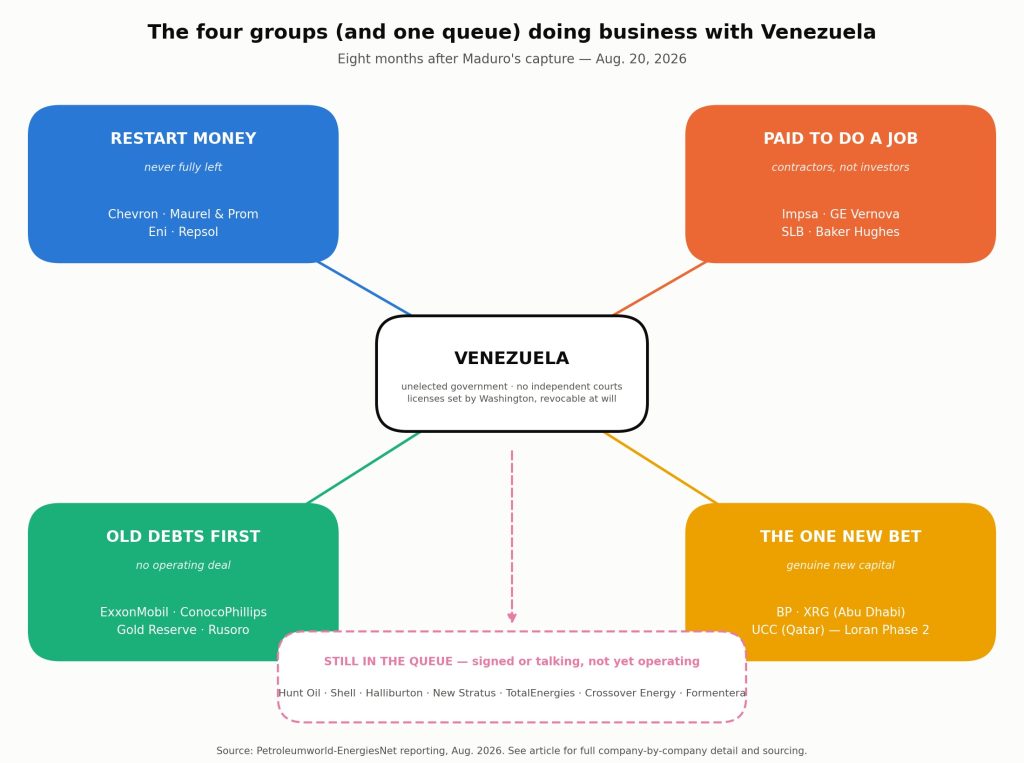
It isn’t a reopening. It’s four different things wearing one headline — restart spending, paid contract work, old-debt negotiation, and, in one case, real new capital — and almost none of it is a bet on Venezuela as a country. It’s a bet on how long Washington keeps backing the current arrangement in Caracas, under a government that is not elected, courts that are not independent, and licenses that have already flipped on and off more than once.
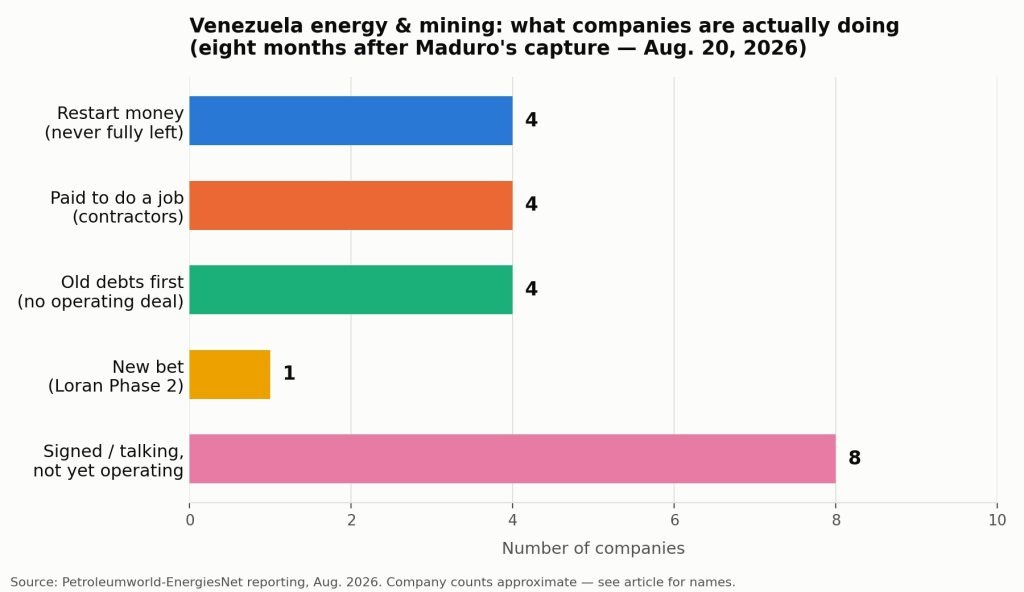
Same breakdown, by the numbers: how many companies actually sit in each group.
Chart: Petroleumworld-EnergiesNet, Aug. 2026.
The legal foundation, in three sentence
U.S. Treasury’s General License 50A (Feb. 18, 2026) authorizes six companies to operate — Chevron, BP, Eni, Shell, Repsol, Maurel & Prom. GL 49 lets anyone else negotiate contingent contracts, but each deal still needs separate, case-by-case approval before it can run, and GL 55 does the same for mining. All exclude Russia-, Iran-, China-, North Korea-, and Cuba-linked firms, so Venezuela’s opening rides on Washington’s relations with four other governments too.
On paper, none of this is new stability: Chevron’s license alone has been pulled and restored four times since 2019, and Eni, Repsol, and Maurel & Prom lost their rights for eleven months in 2025 before getting them back. Venezuela’s own Hydrocarbons Law reform (migration deadline July 28, 2026) and new Mining Law (April 2026) were both passed by an unelected government, with no independent courts to test them.
Four groups — where the companies actually sit
Restart money. Chevron, Maurel & Prom, Eni, and Repsol never left — their people and assets stayed through every sanctions round since 2019. What changed was Washington switching their export rights back on, not a new investment decision. Chevron is producing roughly 280,000 barrels a day as of its August 2026 earnings call and is the only one with a public growth target (+50% by 2028). No source discloses actual restart capex for any of the four. CNPC sits in the same physical category but stays locked out, purely on ownership grounds.
Paid to do a job. Impsa (finishing the Tocoma dam it originally built — equipment sat in storage across four countries for a decade), GE Vernova (grid rehab, roughly 5 GW target over four to five years), SLB (paid reservoir studies), and Baker Hughes are all compensated for defined scopes. Their risk is whether Venezuela pays its bills, not where the country is headed politically — a smaller, different bet than an oil major’s twenty-year commitment.
Old debts first. ExxonMobil (~$984 million), ConocoPhillips (~$8.7 billion award, only a fraction recovered), Gold Reserve (~$1.26 billion claimed), and Rusoro Mining (~$1.3 billion, still fighting over payment) are all negotiating what Venezuela owes them before discussing anything new. None has an operating agreement. The companies with the deepest history here — and the most capital to deploy — are the most cautious.
The one real new bet: BP, XRG (Abu Dhabi), and UCC (Qatar) on Loran Phase 2, awarded August 13, 2026. PDVSA holds no equity in it — the deal needed nothing from Caracas beyond the license itself, which is exactly why it moved fast.
Compare that to the Dragon field-to-Hibiscus pipeline, still stuck: Venezuela is the direct licensor there, and the export leg depends on a Trinidad relationship Maduro himself suspended once already. Dragon needs three things to align (Venezuelan will, the Trinidad relationship, a durable U.S. license); Loran needed one. That’s the whole difference between an award and a wait.
The size of the package
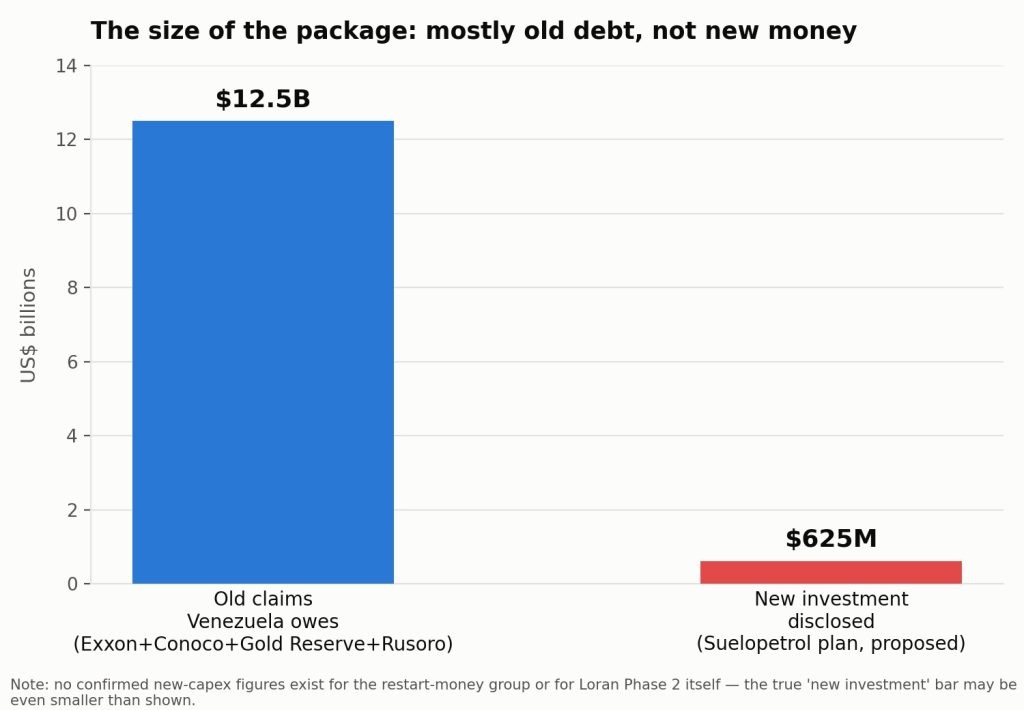
The size of the package: mostly old debt, not new money. Chart: Petroleumworld-EnergiesNet, Aug. 2026.
Nearly every large number in this story is a historical claim, not new money. Add up Exxon, Conoco, Gold Reserve, and Rusoro and Venezuela owes, or is being asked to pay, something north of $12 billion for nationalizations from 2007-2011 — real, but backward-looking.
On the forward side, confirmed new-capex figures are almost nonexistent: none for the restart group, none for Loran Phase 2. The only concrete forward number found anywhere is Suelopetrol’s own proposed $625 million plan — and that’s from a minority partner currently fighting to keep the stake it already has, not a funded commitment. Anyone citing a big total for this “opening” is probably counting old debt as if it were new investment.
Money vs. barrels: what the investment actually buys
Put the dollar figures next to the oil, and the “restart” case looks even thinner. Venezuela’s national production has climbed from a 2020 trough near 350,000-400,000 b/d to roughly 1.0-1.1 million b/d as of July 2026 — a real recovery, but still under half the 2013 level (~2.5 million b/d) and less than a third of the country’s historical peak (~3.5 million b/d in the late 1990s). Chevron’s own growth, per its CFO, has so far been funded out of reinvested local operating cash flow, not fresh corporate capex — the same pattern of “no disclosed new spending” found across Repsol and Maurel & Prom.
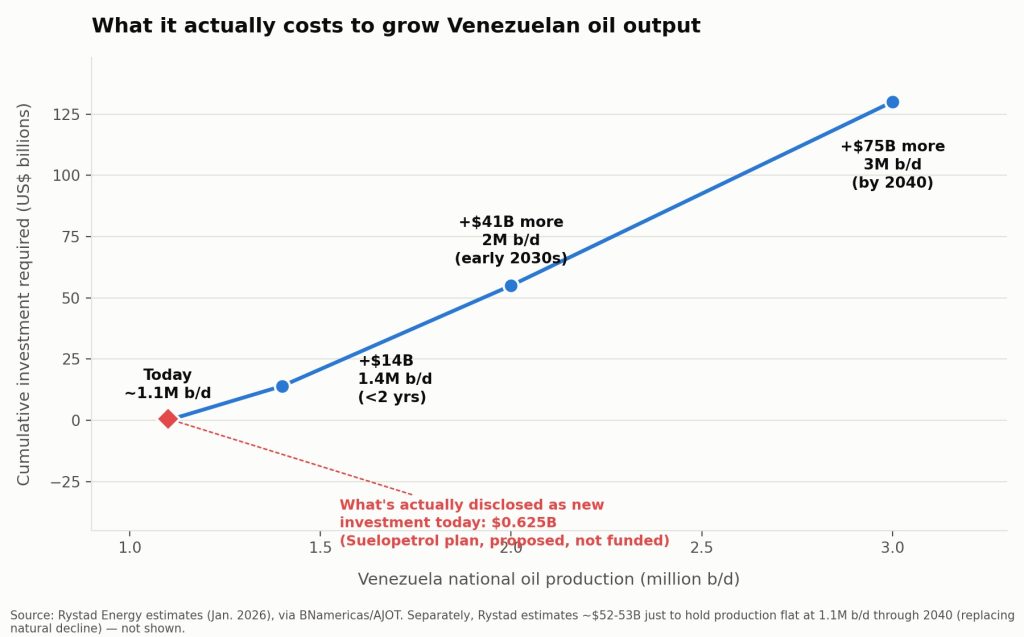
What it actually costs to grow Venezuelan oil output. Source: Rystad Energy estimates, January 2026.
Chart: Petroleumworld-EnergiesNet, Aug. 2026.
Rystad Energy has put a price on real growth, and the chart above tells the story on its own: about $14 billion gets Venezuela to 1.4 million b/d within two years. Another $41 billion on top of that reaches 2 million b/d by the early 2030s. $75 billion more reaches 3 million b/d by 2040. That’s $130 billion, total, for the full climb back — and a separate $52-53 billion just to hold today’s output flat through 2040, since Orinoco wells decline fast without steady reinvestment.
Why isn’t that money showing up? Simple math, per Wood Mackenzie: new Orinoco projects need oil near $80 a barrel to break even under today’s terms, well above the $50-60 range companies normally require before greenlighting new spending. Against a $130 billion price tag, the one real forward-looking number in this whole landscape — Suelopetrol’s proposed $625 million plan — barely registers. That gap is the simplest proof that this “opening” hasn’t yet seen the kind of money it would take to actually move Venezuelan oil output.
Still in the queue
Hunt Oil, Shell (five separate June agreements, not including Dragon), New Stratus Energy, TotalEnergies (crude supply only, not production), Crossover Energy, and Formentera have all signed or are close to signing — none is producing yet.
Halliburton is the clearest case of a two-gatekeeper problem: a Venezuelan court ordered its seized assets returned in August 2026 and cleared it to resume work, but no OFAC license names it, so it’s cleared by Caracas and still waiting on Washington. Equinor’s CEO has ruled out a return entirely — a useful reminder not every major reads this the same way.
One that already left for good: Ypergas. The Guárico-state gas consortium once held by TotalEnergies, Repsol, and Inelectra’s affiliate Inepetrol sold out completely in 2024 — both majors are gone, ownership passed to a Venezuelan private-equity group, and none of it connects to today’s wave. Not every familiar name in this story is coming back.
The local companies nobody profiles
Most of the actual field work — cementing, coiled tubing, drilling barges, engineering — is done by Venezuelan firms paid regardless of who owns the field: Inelectra, Vinccler, CPVEN, PetroAlianza, Troil Services, Maritime Contractors, Arco Services, Operadora IndiOil, and Denarius Pumping Services — all pure fee-for-service contractors, no equity.
Two break that pattern. Suelopetrol holds roughly 40% of Petrocabimas and 1% of Petroindependencia, and is fighting in real time (August 2026) to keep that stake after reports the government moved to hand it to a U.S. firm. Camimpeg, military-owned, holds a joint-venture stake with Perenco.
Beneath both sits a murkier 2023-24 vehicle, “Contratos de Participación Productiva,” used by roughly 16 mostly foreign or opaque companies — as of July 2026 only 9 of PDVSA’s 46 mixed companies had OFAC authorization at all.
The risk, specifically
No elected government, no scheduled election. A licensing structure that’s already flipped multiple times and can flip again by the same executive discretion that created it. Laws passed without an elected legislature or independent courts, in a country that nationalized this sector once already within living memory.
A geopolitical exclusion (Russia, Iran, China, North Korea, Cuba) tied to variables Caracas doesn’t control. And even genuine local equity isn’t safe — Suelopetrol’s live fight is proof a documented Venezuelan ownership stake can still be put at risk by one government decision.
Short term, long term
Near term: the July 28 migration deadline has passed and held; Loran Phase 2 and Cocuina-Manakin both target first gas around 2029; Tocoma’s first phase is 14-19 months; Crossover Energy is targeting January 2027 — five months out.
Longer term, this whole landscape is a market pricing the shelf life of one U.S. administration’s arrangement with one unelected government, not Venezuela’s long-run investability.
Closing: brilliant, contingent, unguaranteed
Venezuela’s energy and mining future could genuinely be brilliant, for the companies positioning inside it now, for as long as the Trump administration keeps backing the current arrangement in Caracas. But it isn’t brilliant on its own terms — it’s brilliant contingent on that backing, and it stops being brilliant the moment that backing changes, or the current regime is no longer the one Washington backs.
Nothing assembled here shows a triple guarantee — judicial, legislative, and institutional, all three, durable and independent of whoever holds power — that the last thirty years can’t happen again. Until that guarantee exists, every deal in this piece, from Chevron’s 280,000 barrels a day to Suelopetrol’s 40 percent of Petrocabimas, is a bet on a person and an administration, not a bet on a country.
Sources: OFAC Recent Actions; Cleary Gottlieb; Baker McKenzie; Holland & Knight; NPR; World Oil; Bloomberg; UPI; World Oil (Exxon/Conoco); MINING.COM; IEA Oil Market Report; S&P Global; BNamericas (Rystad Energy); Wood Mackenzie; BP; Newsday Trinidad; ICIS; Yahoo Finance (Halliburton); NewsBase; Fortune; Inelectra; El Economista; Argus Media; El Nacional; Armando.info.
Elio Ohep, editor@petroleumworld.com
EnergiesNet.com 08 20 2026






2 thoughts on “The Price of Admission: What’s Really Moving in Venezuela’s Energy and Mining Sector”
Pingback: Delta Finance, PetroDelta, and the Proof That Venezuela Still Isn’t Safe for Investors - EnergiesNet
Pingback: Betting on Venezuela, But Not Through “Ownership Stake” - EnergiesNet