


While Caracas pitched Houston on a new era of legal certainty, it quietly finished stripping one investor of a 40% stake — and may be closing in on a second.
By Elio Ohep, Petroleumworld-EnergiesNet
SAN DIEGO, CA
Petroleumworld.com/EnergiesNet.com 08 24 2026
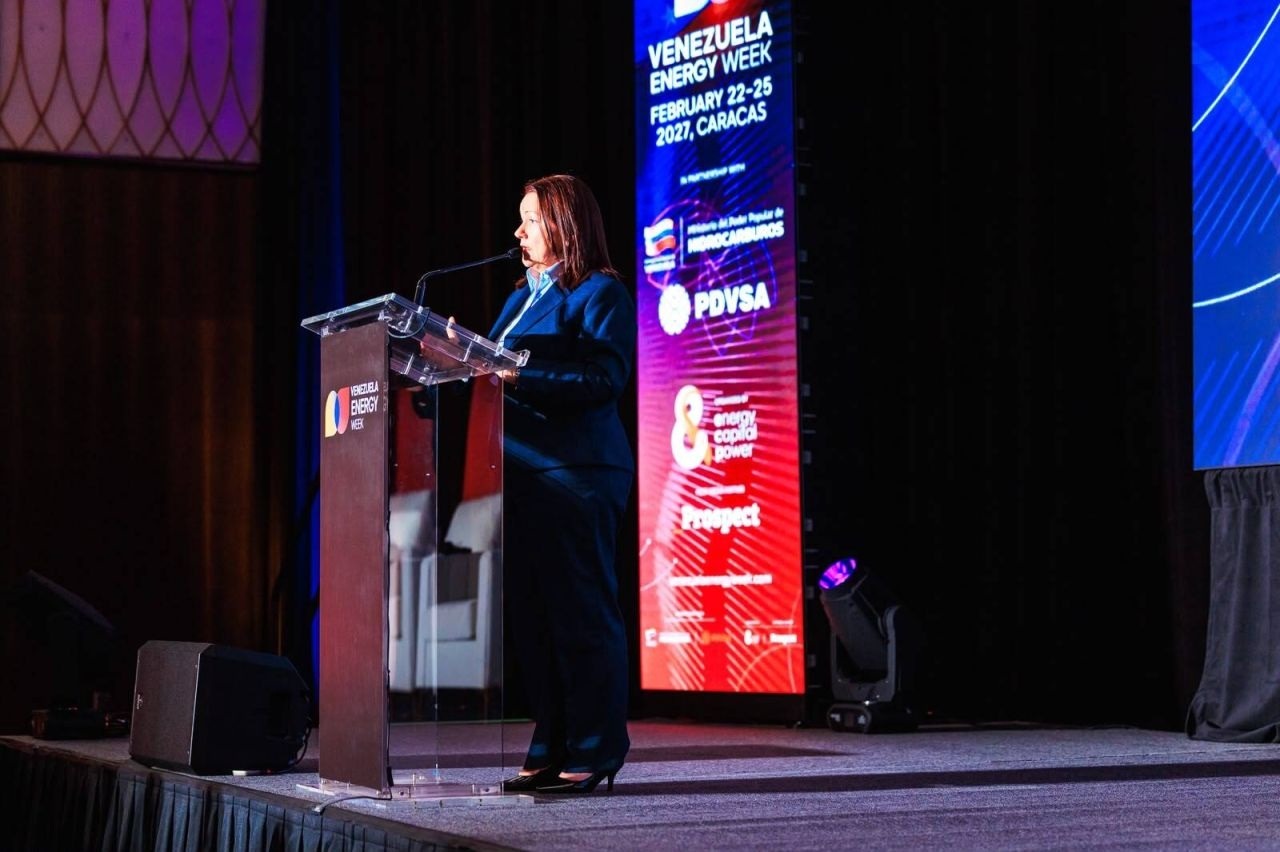
On August 19, Venezuela’s hydrocarbons minister, Paula Henao, stood before roughly 600 executives and investors at The Post Oak Hotel in Houston and made her pitch: new regulations had opened “opportunities for investment across the entire value chain, from upstream to commercialization,” backed by 303 billion barrels of proven crude reserves and a target of 3 million barrels a day, up from today’s roughly 1.25 million. PDVSA Executive Vice President Jovanny Martínez talked infrastructure reliability. Independent operators like Crossover Energy’s Eric McCrady said Venezuela held “more conventional resources and opportunities… than anywhere else in the world.” Hunt Oil and SLB signed new agreements that same week.
That same week, a very different story was surfacing about how Venezuela treats the investors it already has.
At a glance
- Venezuela’s oil ministry revoked DP Delta Finance B.V.’s 40% stake in PetroDelta, a PDVSA joint venture, in a five-week administrative process with no hearing.
- The fields went to Pacific Coast Energy Company (PCEC), a small California operator whose Venezuelan contracts were facilitated by Alejandro Betancourt — a dealmaker who has co-designed the country’s oil-opening strategy with interim president D. Rodríguez since 2024.
- A second, unrelated investor, Suelopetrol, has formally warned that PCEC is now closing in on its stake in the Petrocabimas joint venture too.
- All of this surfaced the same week Caracas courted 600 investors in Houston with promises of legal certainty.
The case: six fields, one signature
PetroDelta was formed in the mid-2000s, when Venezuela’s Ministry of Energy and Oil assigned it a cluster of mature fields in Monagas state — Tucupita, Bombal, Uracoa, El Isleño, Temblador, and El Salto — later folded into the Monagas Sur operating area. PDVSA held 60%. The other 40% passed, around 2016, to interests controlled by the family of the late Venezuelan-Cuban magnate Oswaldo Cisneros, reported in connection with two related entities: CT Energy Holding SRL, a Barbados company, and DP Delta Finance B.V., the Dutch company named in this month’s revocation. That group bought out Texas-based Harvest Natural Resources, PetroDelta’s original private partner.
Who was actually responsible for the fields
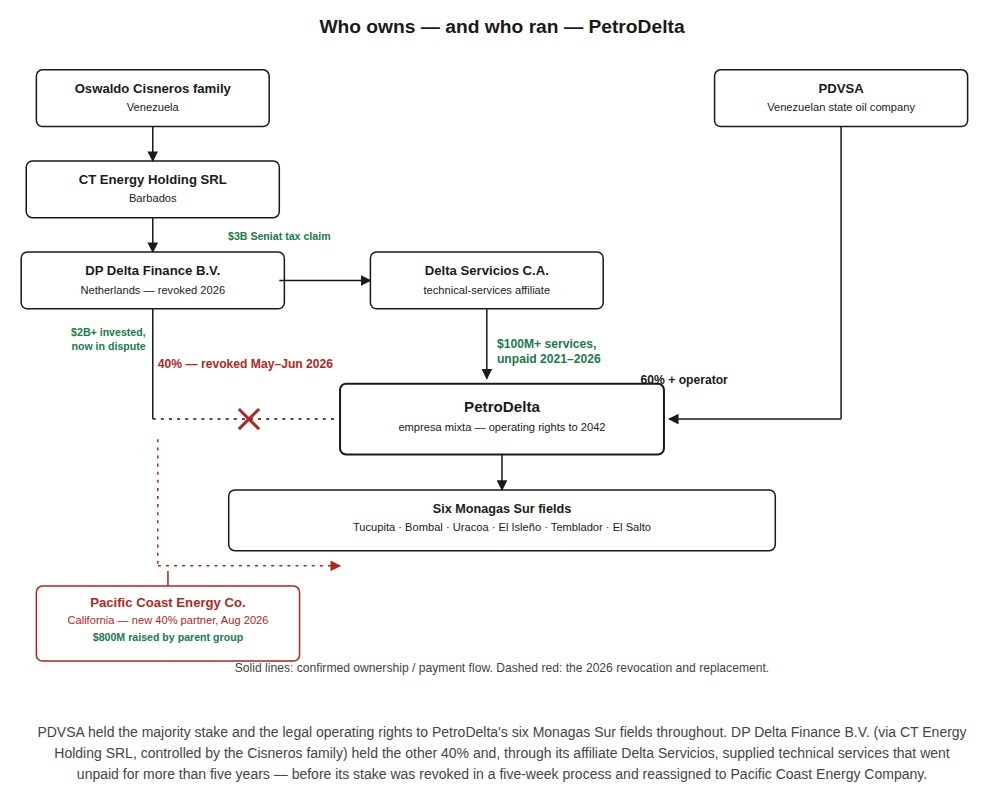
That 2016 handover is where the government’s case begins — but it needs a correction most coverage has skipped. DP Delta/CT Energy was not PetroDelta’s field operator. Worth remembering: PetroDelta is a PDVSA company, like all of Venezuela’s roughly two dozen empresas mixtas, where the law gives PDVSA the majority stake — typically 60% or more — and PDVSA or an affiliate operates. Private partners, however large their stake, are minority investors in someone else’s operation. DP Delta invested more than $2 billion and paid a signing bonus of over $165 million, per Efecto Cocuyo, while PetroDelta itself held the legal operating rights through 2042 — meaning PDVSA operated the very fields whose production it now cites as grounds for revocation.
What DP Delta contributed, through its affiliate Delta Servicios C.A., was technical and production support — and Efecto Cocuyo reports Delta Servicios “prestó servicios por más de 100 millones de dólares sin recibir pago alguno” (provided more than $100 million in services without receiving any payment) between January 2021 and March 2026. That is PetroDelta, majority-owned and operated by PDVSA, failing to pay its own private partner’s technical arm for over five years.
Production did collapse on PDVSA’s watch: from roughly 36,000 barrels a day under Harvest to an estimated 3,700 b/d by the time of the revocation, according to Argus Media — a genuine decline, but one that occurred while PDVSA held the operating rights and was, by DP Delta’s account, not paying for the technical services it received. Separately, Venezuela’s tax authority, Seniat, hit the Cisneros estate with a $3 billion inheritance-tax claim; Argus noted pointedly that “the quickest legal option to capture the $3bn may be to seize the PetroDelta stake and flip it to a new investor.”
None of this makes DP Delta a clean party — a June 2026 La Patilla report found roughly 45 subcontractors in the El Salto field separately owed some $45 million by DP Delta Servicios itself, a dispute predating the revocation. But it undercuts the government’s framing of a private investor that simply failed to perform, when the entity legally responsible for operating the fields was PDVSA all along.
Five weeks, no hearing
The process by which this grievance was resolved looks nothing like rule-of-law enforcement. Per the Cisneros family’s attorney, Juan Domingo Alfonso Paradisi, the oil ministry opened an administrative proceeding in May 2026 and revoked DP Delta’s rights the following month, with no opportunity, he says, for the company to respond to allegations it disputes. He has called the process “abrupt, arbitrary, and unusual.” Voz reports the original concession ran until 2042.
No independent tribunal reviewed any of it. The ministry brought the case, decided it, and reassigned the asset — all within about a month, in the same window Caracas was recruiting new partners in Houston.
Who ended up with the fields — and who put them there
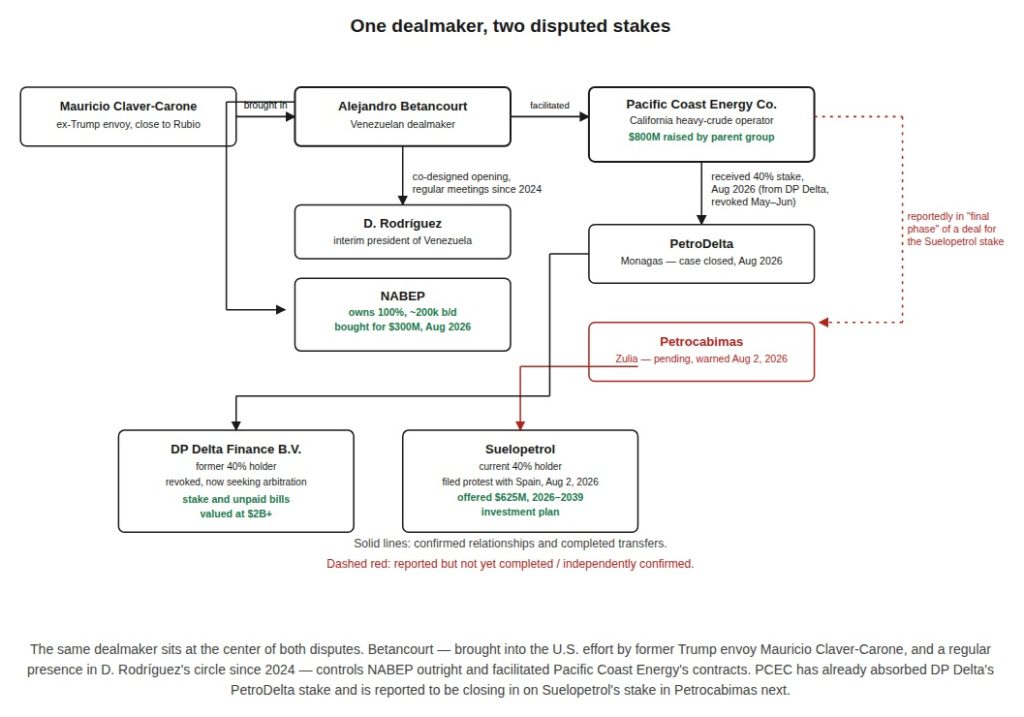
The recipient was Pacific Coast Energy Company (PCEC), a Santa Barbara County, California heavy-crude specialist run by CEO Klaus Hasbo, which announced on July 30 that it had lined up $800 million in equity, debt, and trade finance to develop Venezuelan fields.
That deal did not happen in a vacuum. Fortune, La Tercera, and Mexico’s La Jornada all report that PCEC’s contract, like several others now being signed, was facilitated by Alejandro Betancourt — a Venezuelan businessman who first made his fortune under Hugo Chávez as co-founder of Derwick Associates, which won roughly $5 billion in thermoelectric-plant contracts without competitive bidding, and who now controls North American Blue Energy Partners (NABEP), Venezuela’s second-largest independent oil producer at roughly 200,000 b/d, bought outright for $300 million in early August after he displaced former partner Harry Sargeant III.
Per La Jornada, Betancourt and D. Rodríguez have jointly shaped Venezuela’s oil-opening strategy since 2024, before Maduro’s capture; La Tercera reports he holds “regular meetings” with her and her foreign-policy advisor, Félix Plasencia, and was brought into the U.S. effort by Mauricio Claver-Carone, a former Trump special envoy for Latin America close to Secretary of State Marco Rubio, specifically to help Washington “identify promising energy assets.” Betancourt has faced money-laundering and tax-fraud investigations tied to PDVSA funds in Spain and past extradition proceedings in Switzerland; never charged, he denies wrongdoing.
We found no evidence — none — that any payment changed hands to secure PetroDelta’s fields for PCEC, and we are not alleging one. What is documented, across multiple outlets, is something short of that but still disqualifying for a government trying to prove it now honors contracts: the same person who helped design Venezuela’s oil-reopening framework also personally facilitated the specific contract that benefited from another investor’s fields being stripped away with no hearing.
A second case in the wings
PetroDelta is not the only one — and PCEC is not a bystander in the other case, either. Roughly 200 kilometers away, in the Cabimas Tierra and Tía Juana Tierra fields on Lake Maracaibo, the same script may be playing out a second time.
Suelopetrol is, at its roots, a Venezuelan company — founded in Caracas in 1984, long listed on the Bolsa de Valores de Caracas. But the entity holding its roughly 40% stake in the PDVSA joint venture Petrocabimas is Suelopetrol Exploración y Producción S.L., a Madrid-incorporated holding vehicle set up in 2012, most likely — as with DP Delta’s own Dutch and Barbadian structures — to give the stake the protection of Spain-Venezuela investment treaties.
That Spanish vehicle sent lawyers to Spain’s Economic and Commercial Office at the Caracas embassy on August 2, 2026, asking Madrid to press Venezuelan authorities to “recognize the current ownership of the company” and stop what it fears is coming: transfer of its stake to Pacific Coast Energy Co., reportedly in “the final phase of a strategic alliance with PDVSA” for those same fields. Suelopetrol has countered with its own 2026–2039 plan, offering $625 million in investment to lift output toward 60,000 b/d, and has warned that an unauthorized transfer would trigger “national and international protection mechanisms” — legal language for exactly the kind of arbitration claim DP Delta is now pursuing.
Two further details reached us from a source with direct, on-the-ground knowledge of Suelopetrol’s Petrocabimas operations but could not be independently confirmed: that PDVSA’s payment arrears forced a partial halt in operations at points over the years, and that a Russian entity had, at some stage, sought entry into the field. Both are plausible — payment disputes and Russian energy interests are both well documented elsewhere in Venezuela — but we name them only as open questions, not fact. What is independently verifiable is enough on its own: a decades-old Venezuelan operator, a live investment proposal, and a formal diplomatic complaint warning that the company which just absorbed DP Delta’s stake is closing in on its fields too.
A cheaper option Caracas didn’t take
Even setting the operator question aside, the process itself is hard to defend. If Caracas believed the joint venture needed fresh capital and operating discipline — and a drop from 36,000 to 3,700 b/d is a real basis for that belief, whoever bears responsibility for it — nothing forced the ministry to choose confiscation over a negotiated deal.
A conventional, investor-friendly alternative was sitting right there: broker a farm-down in which PCEC bought into DP Delta’s stake, brought its heavy-crude expertise to bear, and compensated DP Delta for what it gave up — ideally alongside settling the $100 million-plus PetroDelta itself owed Delta Servicios. That is how underperforming joint ventures get restructured in functioning oil jurisdictions, and it would have let Caracas tell Houston a better story: that PCEC’s know-how was rescuing a stranded asset, not inheriting one seized without a hearing from a partner PDVSA had stopped paying.
Instead, the ministry ran a process it fully controlled, revoked the rights outright, and handed the fields to PCEC at no visible cost beyond PCEC’s own committed capital. Whether DP Delta’s position deserved to be terminated and whether the process, the timing, and the beneficiary look defensible are different questions — and a serious investor evaluating Venezuela today has to answer all of them before writing a check.
The unpaid bills don’t disappear
There is also unfinished business on the ledger, and it cuts in DP Delta’s favor. The more than $100 million in Delta Servicios receivables that PetroDelta never paid, combined with the $2 billion the Cisneros heirs say the stake and drilling rights were worth, gives DP Delta a plausible basis to pursue international arbitration over both the unpaid services and the revocation itself — joining a queue that, per Monaldi’s reporting, already includes more than $60 billion in unpaid arbitration awards against Venezuela, among them an $11 billion ConocoPhillips judgment nobody has collected.
An arbitration win, if DP Delta pursues and obtains one, would not return the fields — it would simply add another unenforced number to that pile. That, as much as the revocation itself, is the risk lesson for investors: even when a wronged party is legally right — and on the unpaid-services point, PetroDelta’s own PDVSA-controlled management looks squarely in the wrong — being right and being paid are two very different things in Venezuela.
We have been saying this. This is the proof.
It is not a new argument for this publication. In “Venezuela’s Oil Recovery Still Lacks Investor Guarantees — and Investment Is Not Coming,” we reported that at a January 9, 2026 White House meeting, ExxonMobil CEO Darren Woods called the investment framework “uninvestable” absent “durable investment protections,” and ConocoPhillips CEO Ryan Lance said he wanted PDVSA restructured and its debts resolved before committing capital.
Rice University’s Francisco Monaldi put the diagnosis plainly on his own Substack: “Over the past quarter century of chavismo in power, the Venezuelan state has repeatedly reneged on its agreements with foreign investors,” and recovery requires “a credible and competitive legal framework… approved by a legitimate legislature and enforced by a legitimate executive,” not sanctions relief alone. Harvard’s Ricardo Hausmann went further in a June Project Syndicate column, describing the reopening as “a political economy built on private dealmaking and a mutually beneficial alliance between ruling elites and” allies of President Trump — precisely what the PCEC deal now illustrates with names attached.
Separately, a Blackpeak/ION Analytics review of PDVSA’s new contract terms found early drafts routing arbitration through Hong Kong’s International Mediation Organization — a venue not on OFAC’s approved-jurisdiction list, meaning companies could violate their own U.S. licenses just by using PDVSA’s preferred dispute-resolution forum. Secretary Rubio himself has said only that Venezuela is “in a better place,” while cautioning that “democratic normalization remains incomplete” — there is still no elected government and no scheduled election.
In “The Price of Admission,” we argued that nearly everything being called “investment” in Venezuela’s oil sector today is one of four things: companies like Chevron simply resuming operations they never fully left; paid service contracts compensated regardless of politics; negotiations over decade-old nationalization debts; or, rarely, genuine new capital. Rystad Energy puts the real cost of restoring Venezuela to 3 million barrels a day at $130–183 billion; other estimates run $75–100 billion. What is actually being committed is a rounding error against that number. Our conclusion then stands today: every one of these arrangements is “a bet on a person and an administration, not a bet on a country.”
The bottom line
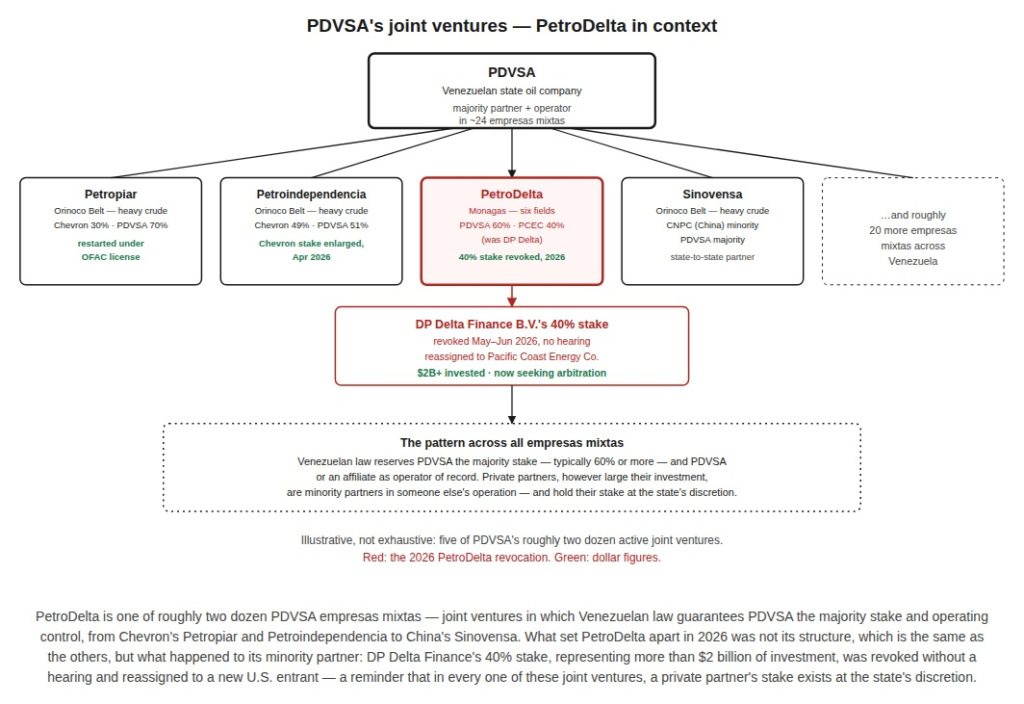
The PetroDelta case confirms it with names, dates, and a dollar figure. As Venezuelan lawyer David Morán Bohórquez wrote in La Patilla on August 23, addressing this exact case: “If a contract can be revoked by administrative decision and assets rapidly transferred to another operator, any foreign participant will ask: Could this happen to me tomorrow?” That is not rhetorical for a Chevron or an ExxonMobil weighing a multibillion-dollar, multi-decade commitment. Right now, the only honest answer Caracas has given is yes, it can, and it did, in five weeks, to a company that had held the stake for a decade.
Venezuela does not lack geology. Its 303 billion barrels of reserves are real, and so is the appetite in Houston to develop them. What it lacks is a government answerable to courts, to an electorate, or to anyone but itself and the dealmakers closest to it. Until that changes, the DP Delta Finance/PetroDelta case is not an aberration serious capital can look past — it is the model, regardless of how many regulations Caracas announces, how many executives it invites to the Post Oak Hotel, or how closely Washington stands behind D. Rodríguez’s government while it happens.
Given all of that, it seems advisable for serious investors to wait on committing capital to Venezuela’s energy and mining sectors until a firm, elected democracy is in place — one answerable to courts and voters rather than to an interim government and the dealmakers around it. Geology will still be there when that day comes. The fields being reassigned this month may not be.
Note: if there are any discrepancies, write to editor@petroleumworld.com
Sources: Bloomberg | Bloomberg Línea | Voz | Argus Media | Efecto Cocuyo | Frecuencia Noticias | Fortune: “Trump’s Venezuela Fixer” | La Tercera: Who is Alejandro Betancourt | La Jornada | La Patilla (David Morán Bohórquez) | Francisco Monaldi (Substack) | Ricardo Hausmann (Project Syndicate) | Blackpeak/ION Analytics | World Oil | NPR | EnergiesNet: “Venezuela’s Oil Recovery Still Lacks Investor Guarantees” | EnergiesNet: “The Price of Admission” | Que.es: Suelopetrol/Petrocabimas request to Spain | El Nacional: Petrocabimas/Suelopetrol dispute | La Patilla: Monagas subcontractors owed $45M | AI
By Elio Ohep, editor@petroleumworld.com
EnergiesNet.com 08 24 2026






1 thought on “Delta Finance, PetroDelta, and the Proof That Venezuela Still Isn’t Safe for Investors”
Pingback: Venezuela’s Oil Land Grab: Mature Fields Go to Operators Who Aren’t Even Wildcatters - EnergiesNet