Lithium, copper, and potash give the country a rare hand to play, but permitting, financing, water governance, and workforce gaps will decide whether resource potential turns into reliable global supply
By Petroleumworld-EnergiesNet
SAN DIEGO, CA
Petroleumworld.com/EnergiesNet.com 08 20 2026
Buenos Aires/San Diego — A new report from the Institute of the Americas concludes that Argentina’s path to becoming a major supplier of critical minerals will be decided less by the size of its deposits than by its ability to permit, finance, and build the projects needed to bring them to market.
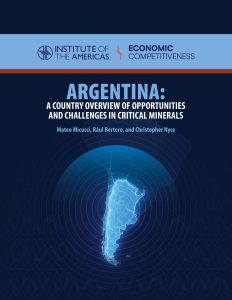
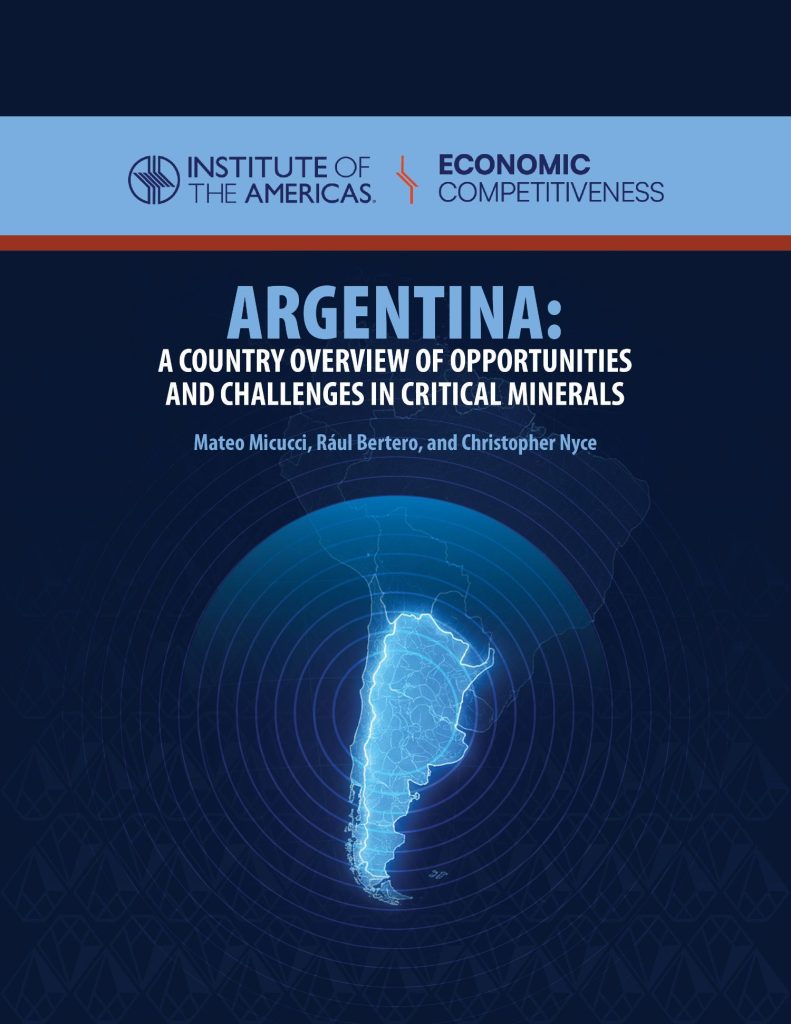
The report, “Argentina: A Country Overview of Opportunities and Challenges in Critical Minerals,” was authored by Mateo Micucci, Raúl Bertero, and Christopher Nyce and builds on the Institute’s hemispheric flagship study, “Critical Minerals: The Western Hemisphere’s Opportunity,” launched April 10 in Buenos Aires before Argentine officials, industry representatives, technical experts, and U.S. Embassy participants. The dominant theme at that event, the authors write, was that “Argentina’s minerals story is ultimately an execution challenge.”
Argentina enters the current global race for critical minerals with world-class lithium resources, an undeveloped copper pipeline, a major potash asset tied to regional food security, and niche minerals relevant to defense and industrial supply chains, according to the report. Unlike many resource-rich jurisdictions, its principal risks are political, macroeconomic, and regulatory rather than tied to conflict or security — Argentina ranks well outside the world’s most conflict-affected tier on the 2026 Global Peace Index, the authors note, meaning its constraints are “more amenable to policy reform, institutional strengthening, and disciplined project development” than to basic stabilization.
Since Argentina’s 1994 constitutional reform, provinces own the mineral resources within their territory and grant exploration and extraction rights, while the national government sets the broader regulatory framework. The 1993 Mining Investment Law provides fiscal stability, and Argentina has since added transparency tools including the Extractive Industries Transparency Initiative and the SIACAM public mining-information system. The Régimen de Incentivo para Grandes Inversiones (RIGI) layers on additional tax reductions and legal-certainty protections for large-scale projects. RIGI-approved mining projects cited in the report include Rincón Lithium in Salta (USD 2.5–2.7 billion) and the Vicuña copper district in San Juan. Still, the authors caution that RIGI should be “treated as a necessary tool, not a complete strategy,” since it “cannot build transmission lines, rehabilitate railways, resolve water conflicts, staff provincial agencies, secure offtake agreements, or create community legitimacy.”
Lithium is Argentina’s most advanced sector, with seven projects in operation in 2025 producing an estimated 116,000 tonnes of lithium carbonate equivalent, concentrated in the northwestern provinces of Jujuy, Salta, and Catamarca. Chinese firms including Ganfeng and Zijin are already embedded in the sector — Ganfeng calls Argentina “an important overseas production base” — and the report argues the country should pursue “diversification rather than exclusion,” welcoming Chinese investment while expanding U.S., European, Japanese, Korean, and other options. Industry representatives interviewed for the report said many Argentine lithium projects would welcome Western partners, but organized financing mechanisms linking them to U.S. and European battery and EV demand remain underdeveloped.
Copper represents “the largest long-term prize,” the report finds. Nine advanced projects across San Juan, Mendoza, Catamarca, and Salta could produce more than 1.5 million tonnes of copper annually by 2035 — equal to as much as 88 percent of current U.S. refined copper imports, by volume comparison — but would require more than USD 28 billion in capital expenditure to develop.
Potash adds a third dimension. South America imports most of its potash, and Argentina currently has no significant domestic production. The Potasio Río Colorado (PRC) project in Mendoza could become the first major potash producer in Argentina and Latin America, with Brazil — which imported USD 4.24 billion of potassium chloride in 2024, mostly from Russia and Canada — as its natural buyer. The report frames PRC’s transport and financing needs as a test of whether the United States and its partners can adapt elements of the Lobito Corridor financing model, used in Africa, to the Americas.
Uranium, while unlikely to define Argentina’s mining economy by volume, drew particular attention given the country’s existing nuclear-energy sector and current reliance on uranium imports; the report identifies 21 uranium projects and 34,250 tonnes of recoverable identified resources.
On social and workforce issues, the report says water governance is the most sensitive constraint, given lithium’s arid brine basins and copper’s long-term water demands, and calls for basin-level monitoring and transparent baseline data. Argentine National Deputy for Catamarca Fernanda Ávila told researchers that “community engagement should begin at the prospecting stage.” Multiple industry sources warned that Argentina lacks enough geologists, hydrogeologists, environmental specialists, and skilled trades workers for several major projects to advance at once — a gap the Lundin Foundation, working on the binational Vicuña copper project with Chile, said could be narrowed by transferring Chilean operating experience to Argentine crews rather than relying long-term on expatriate staff.
Internationally, the report points to the February 2026 U.S.-Argentina critical minerals framework as the most developed bilateral channel, covering financing, offtake, permitting, and geological mapping, and recommends activating U.S. tools such as USTDA, DFC, and EXIM against specific bottlenecks like PRC’s logistics or San Juan’s copper infrastructure. It also cites the EU-Mercosur trade agreement, which became provisional on May 1, 2026, and a reactivated 1997 Argentina-Chile mining-integration treaty as additional avenues, alongside financing support from the IDB, CAF, and other development institutions.
The report closes with a phased roadmap — from a national-provincial priority-project list and public permitting dashboard within 12 months, to water monitoring and workforce programs within three years, to new transmission, rail, and port infrastructure over five years. “Success would make Argentina not only a larger mineral exporter but also a more credible mining economy and a more important hemispheric supply partner,” the authors conclude. “Failure would leave its resource potential constrained by institutional and infrastructure limits. The difference will not be geology. It will be execution.”
Source: Institute of the Americas, “Argentina: A Country Overview of Opportunities and Challenges in Critical Minerals” (April 2026), https://iamericas.org/wp-content/uploads/2026/08/Argentina-Critical-Minerals-Report.pdf
editor@petroleumworld.com
EnergiesNet.com 08 22 2026