By Liam Denning
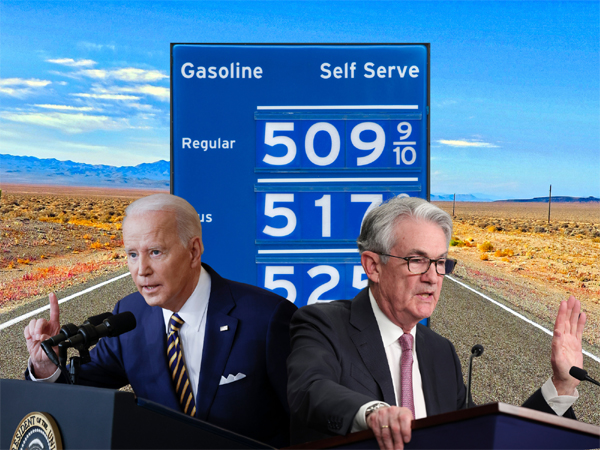
I normally visit the gas station in something of a fugue state, blocking out all sensory information. But even I have noticed two things of late. One is round-number readouts on the pump display, indicating that the previous customer targeted a dollar amount rather than filling up (hat-tip to Dan Pickering of Pickering Energy Partners for that one). The second is a proliferation of droll little stickers on pumps depicting President Joe saying “I did that!” and pointing his finger at the price window.
Both speak to the pain caused by $5-ish gasoline and to the blame heaped on US presidents for any price increase. But drivers might also be feeling not too warm and fuzzy toward another official nearby the White House: Federal Reserve Chair Jerome Powell.
In June, average pump prices topped $5 a gallon for the first time ever. For a typical Ford F-150 truck — the best-selling vehicle in the US — that means paying about $130 every time you fill up (more like $150 in California). Spending on motor fuel as a share of disposable income, at roughly 2.5%, is back up to where it was in late 2014. Still, that share remains smaller than in prior energy crises. And the recent tumble in oil prices, if it lasts, should offer some relief. Already, the American Automobile Association’s daily average price has dropped from over $5 to under $4.80.
Gasoline is the most visible but not the biggest cost of driving. The price of vehicles has jumped, largely because of pandemic-related hits to supply chains. Sticking with the Bureau of Economic Analysis’ income and expenditure data, the all-in cost of buying vehicles and parts and the fuel to run them has risen to about 6.5% of disposable income, a level last seen in late 2013.
This is where Powell comes in — because another important, if less prominent, cost just breached the “five” level, too.
These are two sides of the same coin, of course, as the inflationary impulse coursing through gas pumps and dealer lots (and more) engenders a response from the Fed and bond markets. For drivers, a combination of rising vehicle prices and the cost of borrowing to pay them means a bigger monthly hit. Since January 2021, when Biden took office, the implied average payment on a 72-month loan for a new vehicle has risen from about $520 to almost $600, based on my calculations.(1)Now add in the cost of gasoline for a driver averaging about 1,000 miles a month, and the all-in cost of owning and fueling a new vehicle has jumped from about $600 a month to almost $800.(2)Of that increase, 40% relates to the loan payment rather than the pump price.

At the higher end, combined monthly loan and fuel payments have gone into four figures. At the beginning of 2021, a typical Ford F-150, for example, might have set you back about $800 a month; today, you would be looking at $1,050.(3)
Strangely enough, despite those anecdotal signs around the gas pump, we have yet to see drivers retreat en masse or switch to smaller models. Trucks and SUVs were 78% of new vehicle sales in June, in line with May and a bit higher than June of last year. Vehicle sales overall are down but high prices — including dealer gouging — scarce inventory and strong back orders suggest that constrained supply is a bigger issue than collapsing demand. Higher rates are also a problem for electric vehicles; while they are cheaper to fuel, they cost more upfront to buy.(4)
And yet, considering those figures for share of disposable income, maybe this isn’t so strange. We’re in a weird moment, rebounding from a once-in-a-century pandemic while absorbing a generational shift in the direction of inflation and interest rates, combined with an old-fashioned geopolitical energy shock courtesy of the Kremlin. Unemployment is less than 4%, but our attention is consumed by $5 gasoline.
The simultaneous increase in the costs of gasoline and car ownership, however, looks unsustainable. The Fed’s ultimate objective is for higher interest rates to take down those vehicle prices, or at least slow their ascent, as well as curb our seemingly innate enthusiasm for gasoline.
The recent decline in pump prices, bloated inventories at retailers and easing inflation bets in the bond market offer some hope that the Fed’s offensive will be brief. On the other hand, the economic swings of the past 18 months have wrong-footed many experts, and Russia’s war, affecting everything from gasoline to grain, is ongoing. Automakers might yet see their supply crunch flip to a demand gap — manifesting itself less in a further drop in the number of vehicles sold and more in a revival of big discounts to move them. The cure for the high cost of driving isn’t likely to win drivers’ gratitude either.
More from other writers at Bloomberg Opinion:
• Housing Stands in the Way of September Fed Pivot: Jonathan Levin
• Surge in Gas Prices Isn’t as Painful as It Looks: Robert Burgess
• Markets Are Signaling a Pyrrhic Inflation Victory: John Authers
(1) This assumes a 72-month loan with a 20% down payment, using the monthly average typically-equipped retail price as per Edmunds.com. Average loan rates as per Bankrate.com.
(2) This assumes average vehicle miles traveled calculated on a per vehicle basis using Federal Highway Administration data. Vehicle-miles-traveled data, seasonally adjusted, run through April 2022; data for May and June are calculated as per prior year data for those months plus 2%, in line with growth observed in March and April. Vehicle fleet numbers as per 2020 data (latest year available). Annual average fuel economy data supplied by the Environmental Protection Agency through 2021, which I extend through the first half of 2022.
(3) This assumes a 72-month loan with a 20% down payment at average Bankrate.com rates of 4.21% and 5.25% in January 2021 and June 2022, respectively. Typically-equipped retail price for a Ford F-150 truck in January 2021 of $55,726 and in May 2022 (latest month available) of $64,025, as per Edmunds.com data. Gasoline price of $2.42 per gallon in January 2021 and $4.80 currently. Assumes an average 22 miles per gallon and 1,000 miles driven per month.
(4) A Ford F-150 Lightning getting a nominal 1.7 miles per kilowatt-hour costs about $62 to charge at average residential electricity tariffs for a someone driving 1,000 miles a month. That is less than a third of the monthly gasoline cost for a regular F-150 getting 22 miles per gallon at current prices. On the other hand, a reasonably well-equipped Lariat version of the Lightning will cost you upward of $70,000, assuming you can find one.
_________________________________________________________