Mayra P. Saefong, William Watts, MarketWatch
SAN FRANCISCO/NEW YORK
EnergiesNet.com 07 21 2022
Oil futures settled lower on Wednesday, pulling back following a three-session climb, after the U.S. government reported a modest weekly fall in domestic crude supplies, but said gasoline inventories climbed by more than three million barrels.
Meanwhile, natural-gas futures rallied by more than 10% on the back of hot weather in much of the U.S., which is likely to boost demand for the fuel.
Elsewhere, Russian President Vladimir Putin signaled that natural-gas flows to Europe will resume via the Nord Stream pipeline but could continue to see curbs unless a dispute over sanctioned parts is resolved.
Price action
- West Texas Intermediate crude for August delivery CL.1, -2.72% CLQ22, -1.54% fell $1.96, or 1.9%, to $102.26 a barrel on the New York Mercantile Exchange on the contract’s expiration day. The most-actively traded September contract CL00, -2.74% CLU22, -2.73%, which is now the front month, shed 86 cents, or nearly 0.9%, to $99.88 a barrel.
- September Brent crude BRN00, -2.42% BRNU22, -2.43%, the global benchmark, lost 43 cents, or 0.4%, at $106.92 a barrel on ICE Futures Europe.
- Back on Nymex, August gasoline RBQ22, -4.20% fell 1% at $3.2754 a gallon.
- August heating oil HOQ22, -3.00% edged down by 0.6% to $3.6043 a gallon.
- August natural gas NGQ22, -4.05% climbed 10.2% to $8.007 per million British thermal units, the highest front month finish since June 13, according to Dow Jones Market Data.
Market drivers
Energy markets continued their “large swings, caught in a tug-of-war between supply fears with new Western sanctions being considered [against Russia] and expectations of economic weakness,” analysts at StoneX’s energy team in Kansas City wrote in a daily newsletter.
Read: Energy and materials stocks face rough ride as commodity prices come off the boil, says economist
Production capacity limits among members of the Organization of the Petroleum Exporting Countries were also a key focus for traders on Wednesday.
Saudi Arabia’s Crown Prince Mohammed bin Salman had told U.S. President Joe Biden, during his Middle East trip last week, that the Kingdom’s ultimate maximum output capacity is 13 million barrels a day, a news report from Bloomberg pointed out on Wednesday. Saudi crude production is poised to average 10.7 million barrels a day in 2021, the report said, implying that the Saudis are already producing oil near peak capacity.
Oil had settled higher on Tuesday, with supply concerns in focus.
Nearby Brent futures contracts have surged relative to later dated contracts, with the spread between the September and October BRNV22, -2.46% contract widening to nearly $4.50 a barrel, “highlighting the tightness that still persists in the oil market,” said Warren Patterson, head of commodities strategy at ING, in a note.
Meanwhile, the European Union’s executive office on Wednesday proposed that member states cut their natural gas use by 15% over the coming months to ensure that any full Russian cutoff of supplies to the bloc won’t fundamentally disrupt industries next winter.
Supply data
On Wednesday, the Energy Information Administration reported that U.S. crude inventories fell by 400,000 barrels for the week ended July 15. That followed two consecutive weeks of crude supply gains.
On average, analysts expected a decline of 200,000 barrels, according to a poll conducted by S&P Global Commodity Insights. The American Petroleum Institute on Tuesday reported a 1.9 million-barrel increase.
The draw to crude inventories was “largely a reflection of crude exports reportedly surging over 700,000 [barrels per day] week-on-week,” Troy Vincent, senior market analyst at DTN, told MarketWatch. “The strength in U.S. exports follows the rapidly widening discount for WTI relative to Brent through the second half of June, which is now translating into stronger export loadings.”
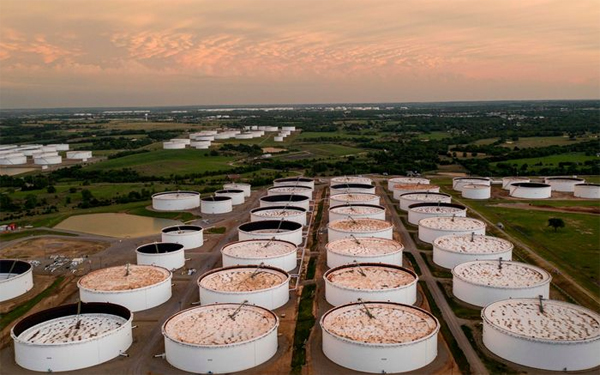
Crude stocks at the Cushing, Okla., Nymex delivery hub edged up by 1.2 million barrels for the week, while stocks in the Strategic Petroleum Reserve fell by 5 million barrels, the EIA said.
The fall in crude supply “indicates that even the release of oil from the [SPR] has not been enough to quench demand,” said Colin Cieszynski, chief market strategist at SIA Wealth Management.
Still, with crude oil having come off of three strong days, Wednesday’s price action felt like a “normal and common consolidation of recent gains,” he said.
The EIA report also showed a supply increase of 3.5 million barrels for gasoline, while distillate stockpiles fell by 1.3 million barrels. The analyst survey called for inventory gains of 400,000 barrels for gasoline and 800,000 barrels for distillates.
The increase in gasoline supplies came as total gasoline product supplied, a proxy for demand, averaged 8.7 million barrels a day over the last four-week period, down 7.6% from the same time a year earlier, the EIA reported.
—The Associated Press contributed to this report.
marketwatch.com 07 20 2022