Dan York, Director Online Content
WASHINGTON
EnergiesNet.com 05 17 2022
The word “Splinternet” is making headlines everywhere, a result of the forces now holding the world’s attention. It sounds obscure, but it could have a profound impact on how we live. So what is it?
Let’s say that on a regular day you visit Facebook, Wikipedia, and Google. With an open Internet, you are able to visit these sites without giving it much thought. Now imagine this happening instead:
- facebook.com – Blocked. You can’t get there.
- en.wikipedia.org – You should get to English Wikipedia, but instead you see what looks like a version of Wikipedia in a different language. And you aren’t even sure if it is the real Wikipedia.
- google.com – You wind up not on Google, but instead on some other search engine, searching only government approved sources.\
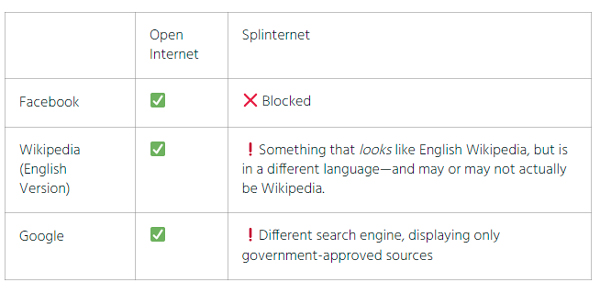
This is the Splinternet. Where the addresses you normally use on the open Internet can take you to completely different places—or sites can be blocked entirely. It’s where you can’t trust the names and addresses to take you to where they’re supposed to. It’s where borders are added to a borderless system. It’s where the free flow of information becomes restricted and suppressed.
The “Splinternet” is the idea that the open, globally connected Internet we all use splinters into a collection of fragmented networks controlled by governments or corporations.Tweet
These separate networks might use the same names and protocols as the global Internet, but the information you get from each intranet is what the government or company wants you to see.
So while at first glance it may look like the global Internet you’re used to, it’s not. It’s “RussiaOnline” or “RUNet,” to use an example from current headlines. You may be able to use the same browsers and mail programs, but you can’t get to the same places. And even if you can, you have no idea if the local government is monitoring everything you do.
This Splinternet idea is already happening—and it’s having a profound effect on more than a billion people. The most famous example is China’s “Great Firewall.” When you visit China and go online, you are not on the global Internet. You are on the Chinese government’s so-called “safe” version. You see what they want you to see—and use what services they want you to use. But it’s not the Internet the rest of the world has come to rely on.
The Russian government has said they want to follow China’s example, creating their own “sovereign” version of the Internet. They haven’t been able to—because the global Internet has had many connections into Russian networks. But that is changing. In the wake of the invasion of Ukraine, there are calls to disconnect Russia from the Internet. The Russian government is seizing on this chance to try to create the state-controlled “RussiaOnline” they have wanted all along.
Other authoritarian countries are watching to learn how they can break away, too.
We can’t let this happen. If we don’t stop it, we could break the globally connected Internet. The Internet that allows us to connect, communicate, collaborate, and create. The Internet that has become the backbone of the world economy and our lives. The Internet that is a lifeline for so many.
The Internet has succeeded because of its open, unrestricted access and common protocols. To keep it that way, we must stop its splintering and fragmentation.
internesociety.org 04 23 2022