These aren’t explorers risking capital to find oil — they’re untested operators, backed by Washington, taking over fields already proven and producing. The major oil companies, with far more to lose, are following a separate, more cautious legal path.
By Elio Ohep, Petroleumworld-EnergiesNet
SAN DIEGO, CA
Petroleumworld.com/EnergiesNet.com 09 02 2026
Since late August, almost as soon as the deal between Washington and Caracas was announced, Venezuela has entered an oil-field feeding frenzy that goes well beyond the 17 fields covered by that deal.
Chevron is negotiating to expand its position in Carabobo. India, Italy and Colombia are signing this same week through ONGC, Eni and GeoPark. A Swedish oil company is taking operational control of a field Shell walked away from years ago. A Coinbase co-founder is trying to pry three blocks away from a Brazilian oil company that had just started investing in them. And a Venezuelan family with fifteen years in the business lost its fields in five weeks, without a hearing, to a barely-known California company.
Taken together, these aren’t isolated anecdotes. It’s the same story told several times over, with the same pattern underneath.
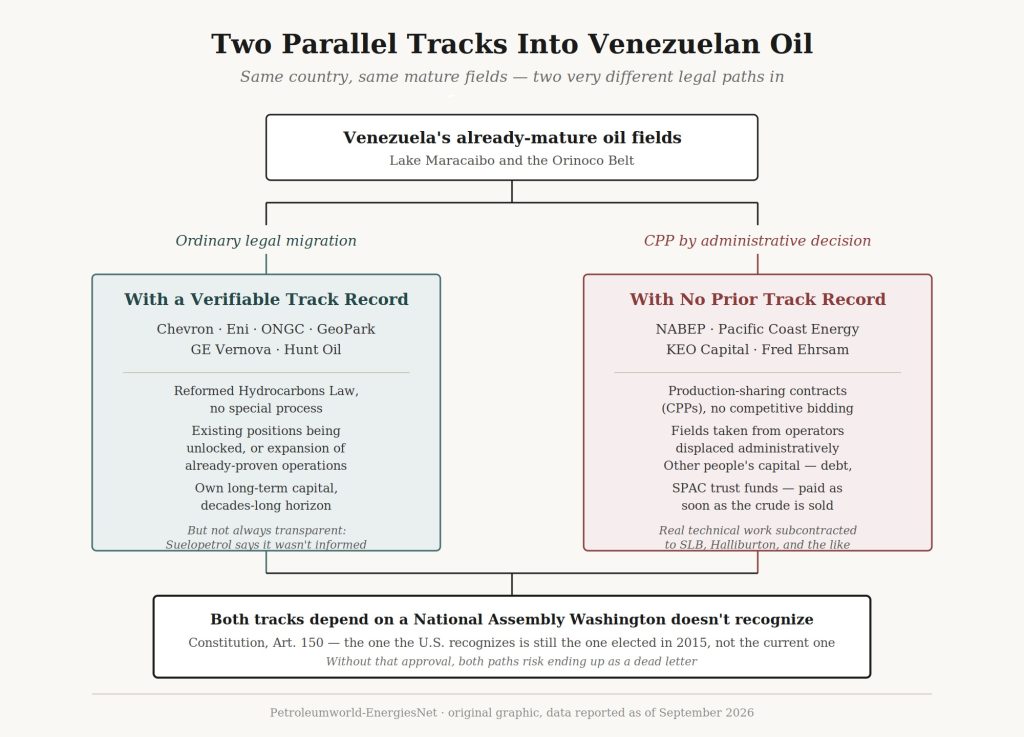
In short: Venezuela is living through two oil scrambles at once. One migrates contracts toward the reformed law and includes oil companies with a real track record — Chevron, Eni, ONGC, GeoPark. The other assigns already-mature fields, with no bidding, to operators with no track record in the sector at all, who subcontract the technical work and get paid as soon as the crude is sold. Both tracks depend on a National Assembly Washington doesn’t recognize as legitimate — the same knot we flagged in our first piece on this deal.
Two Parallel Tracks
A warning that already existed
This pattern isn’t new. In February 2026, Reuters reported that both governments had suspended 19 oil and gas contracts signed under Maduro, over doubts about the credentials of the signing companies: “some of the companies are little known and the deals were signed while Venezuela was under U.S. sanctions,” according to that report. PDVSA kept selling crude under those contracts even while they stayed suspended. The very review process meant to weed out opaque operators ended up, months later, opening the door to another round of equally opaque ones.
Two tracks, not one
One is the political deal between Trump and Delcy Rodríguez, which hands NABEP control — via production-sharing contracts, or CPPs — of 17 fields, a mix of “green” blocks and “brown” fields already operating, per the leaked document laying out the deal, covering roughly 65 billion barrels of proven reserves, the figure Trump himself cited on Truth Social.
A number that doesn’t add up
On duration there’s a discrepancy we haven’t been able to resolve. The National Assembly approved, in an extraordinary session on September 1, a deal with an “initial term” of 25 years — the same figure Delcy Rodríguez confirmed. A separate El Nacional report, though, based on details the White House disclosed, spoke of 100-year concessions to NABEP. We’re flagging both figures rather than picking one.
The other track
The other is broader and less visible: a general migration toward the reformed Organic Hydrocarbons Law, giving foreign firms more flexibility. That’s how Chevron (expanding in Carabobo), India’s ONGC, Italy’s Eni (already present via the Perla gas field and Corocoro) and Colombia’s GeoPark (negotiating the Bare field, with potential reserves up to 1 billion barrels) are entering. None depends on NABEP.
The date on the calendar
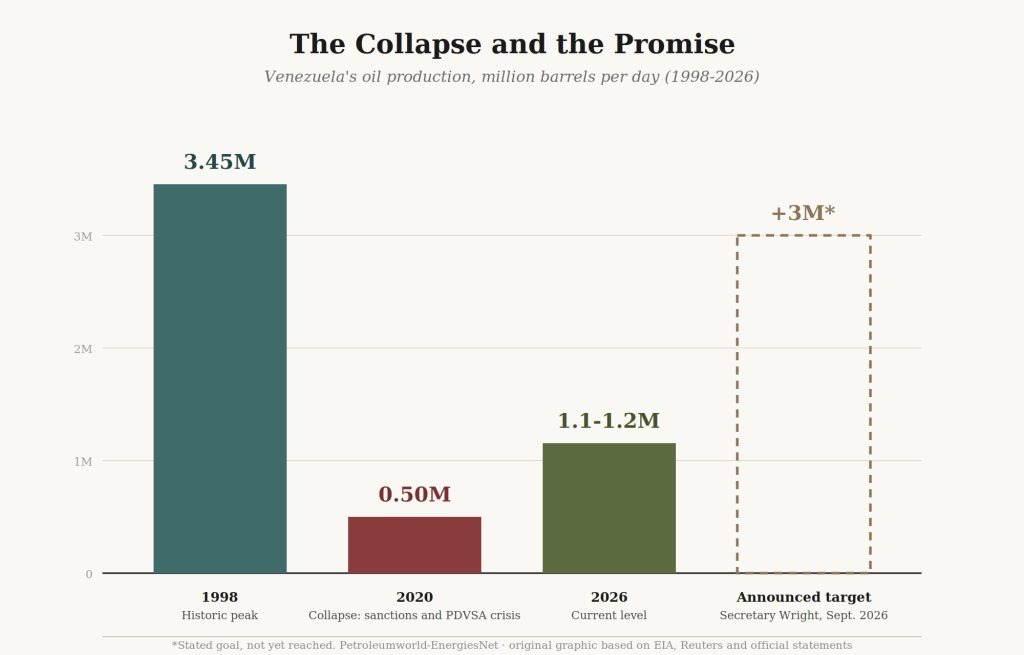
The formalizing had its own date: Energy Secretary Chris Wright landed in Caracas on September 1, a day after the Assembly led by Jorge Rodríguez approved handing Washington control of a fifth of the country’s reserves. The next day, alongside Chevron executives, he said these deals would “more than double” Venezuelan output — from today’s 1.1-1.2 million barrels a day toward the late-1990s peak of more than 3 million — though he acknowledged refining capacity, not volume, is what weighs most on gasoline prices today.
Who already had a foothold, and who’s arriving from scratch
ONGC Videsh isn’t a newcomer: it already held 40% of San Cristóbal and 11% of Carabobo. What changed is that Washington granted it an OFAC license its director, Anupam Agarwal, described this way: “we now have full freedom to work on the Venezuela project” — the license unlocks positions it already held, not new fields. Something similar applies to GE Vernova, which signed a memorandum in June (not yet a final contract) to rehabilitate the national power grid. Neither case fits the “operator with no track record” pattern: both are established players who simply had the regulatory path cleared for them.
Even the legitimate track isn’t free of opacity
Even so, Suelopetrol — a Venezuelan partner holding 1% of PetroIndependencia, Chevron’s joint venture in Carabobo — told Reuters it was never notified of a meeting that would authorize Chevron to raise its stake to 49%. Neither Chevron nor PDVSA responded. Keeping minority partners in the dark, then, isn’t exclusive to the pseudo-operators — it shows up in the record of the biggest oil company operating in Venezuela too.
It’s in the rest of this second track where the more troubling pattern shows up: alongside the legitimate unlockings, operators with no verifiable track record at all are moving in, taking over fields that are already mature and already have prior production.
The Pattern: Pseudo-Operators on Fields That Are Already Mature
NABEP
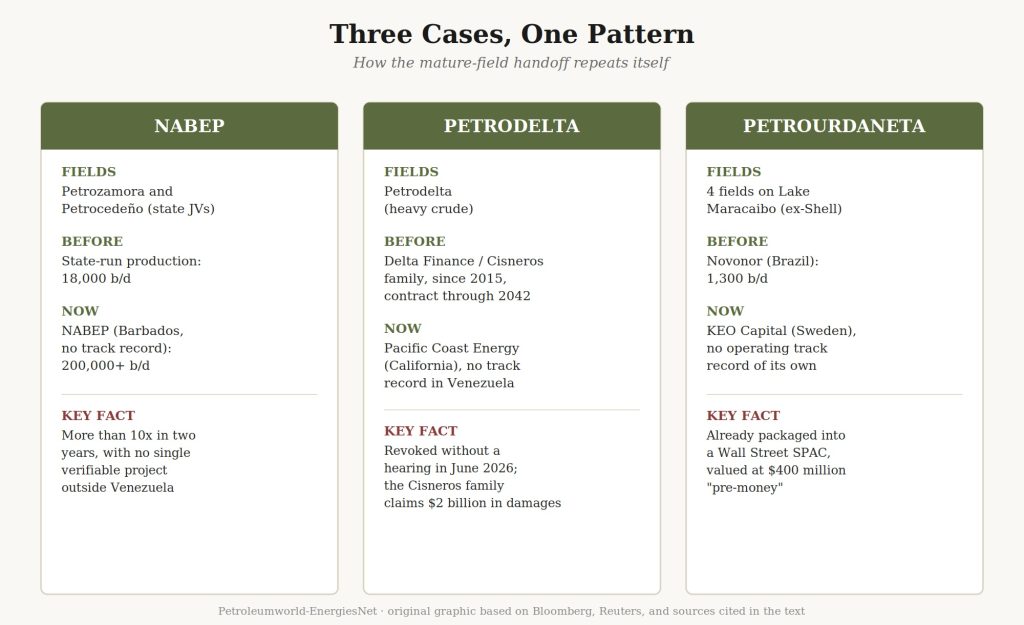
The most visible case — covered in detail in a separate piece. With not a single verifiable project outside Venezuela and based in Barbados, it went from 18,000 to more than 200,000 barrels a day in two years operating the CPPs for Petrozamora and Petrocedeño, two joint ventures with decades of infrastructure and production.
Petrodelta
Follows the same script with a darker twist. The Cisneros family, through Delta Finance, had invested since 2015 in Petrodelta’s mature fields, under a contract already extended through 2042.
In May 2026 the Ministry of Hydrocarburos opened an administrative proceeding against the company; in June it revoked its rights, without a hearing; and in July the fields passed to Pacific Coast Energy Company (PCEC), a small California operator — with real heavy-crude experience, but none in Venezuela — that had already raised $800 million.
Silvestre Tovar of Delta Finance called it a confiscation; the Cisneros family is claiming $2 billion in damages. Analyst David Morán Bohórquez put it simply: if a contract can be revoked by administrative decision and handed to another operator within weeks, any foreign investor will wonder if the same could happen to them.
PetroUrdaneta
The quietest case, and maybe the most revealing: four mature fields in Lake Maracaibo, originally Shell’s, now producing barely 1,300 barrels a day. Its 40% stake moved from Brazil’s Novonor to Sweden’s KEO Capital, which has no prior operating track record of its own.
What it does have is a sophisticated financing plan: on July 15, KEO Capital signed a letter of intent with Lionheart Holdings — a Nasdaq-listed SPAC (ticker CUB) with roughly $200 million in trust — to take a new company built around the Venezuelan asset public, valued at $400 million “pre-money.” Before producing meaningfully more oil, PetroUrdaneta is already being packaged as a Wall Street investment vehicle.
The Physical Work Is Still in the Same Hands It’s Always Been In
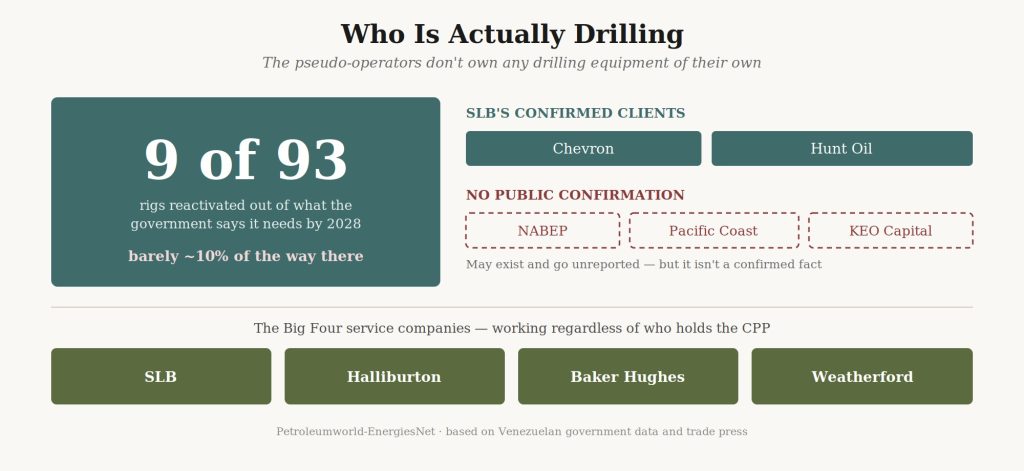
None of the pseudo-operators has its own drilling capacity — that work is still done by the same big service companies as always. SLB (formerly Schlumberger) plans to reactivate up to 15 rigs already stored in the country, with Halliburton, Baker Hughes and Weatherford maintaining their own presence. Venezuela’s government estimates it needs 93 rigs in total through 2028; so far only nine have come out of storage — a sense of how early this process still is.
SLB’s most visible confirmed client is Chevron, not any pseudo-operator. Hunt Oil, a U.S. independent with a real track record, also signed a CPP with SLB as its services partner. As far as we could verify, there’s no public confirmation that SLB, Halliburton, Baker Hughes or Weatherford have contracts with NABEP, Pacific Coast or KEO — that may be happening and simply not reported, but it isn’t confirmed. Trade press does note that “foreign service providers generally prefer to work with established companies with a track record of reliable payment,” a discreet way of saying they doubt the newer operators’ solvency. Either way, the outcome is the same: whoever holds the CPP paperwork, the real technical work stays concentrated in the same four majors it always has. The pseudo-operators supply political access and capital; the expertise is still borrowed.
The Most Extreme Case: a Coinbase Co-Founder
If one example sums up how far this frenzy has gone, it’s Fred Ehrsam. Co-founder of Coinbase and crypto firm Paradigm, with no prior oil experience, Ehrsam has visited Caracas several times since Maduro’s capture. In May he pitched Delcy Rodríguez and U.S. officials a three-pillar plan — stablecoins, blockchain infrastructure, and tokenizing Venezuelan assets — to attract capital.
According to Bloomberg, he’s now seeking direct control of three blocks in the Orinoco Belt — Boca, Guico and Guara — while Washington weighs revoking the contract of the current operator: Alvorada Heavy Industries, a Brazilian company with serious capital that in April was announcing plans to multiply output from 4,000 to 30,000 barrels a day. This wouldn’t be about removing a sanctioned operator, but about displacing a good-faith partner to hand the fields to someone with zero oil track record.
And there’s an irony: Coinbase, the platform Ehrsam co-founded, still blocks Venezuelan users under OFAC sanctions compliance — the opposite of the “financial inclusion” pitch behind his own proposal.
The Name That Keeps Coming Up
Betancourt, again
One name keeps showing up behind several of these deals. Alejandro Betancourt, NABEP’s chief executive, is — per our own earlier reporting — the same dealmaker who helped broker Pacific Coast Energy’s contract over Petrodelta’s fields. It’s not the only time his name turns up linked to more than one player in this scramble; that thread deserves its own investigation, which we’re setting aside for a dedicated piece.
Rubio’s defense
Secretary of State Marco Rubio himself defended him. In an interview with journalist Sergio Novelli, published September 1 by El Nacional, he said Washington reviewed Betancourt’s background “in our system” and found no open investigation against him — though he acknowledged Betancourt backed the opposition during Guaidó’s interim presidency in 2019, calling that “complex.”
He also insisted the arrangement “isn’t a deal with the interim government,” but with a private company. That distinction clashes with Trump’s own language: announcing the signing on Truth Social, he called Delcy Rodríguez “the highly respected interim president of Venezuela” — the head-of-state treatment Rubio avoided days later.
The $170 Billion Warning Exxon Hasn’t Forgotten
“Nothing has changed”
On August 31, the same day Chevron, GE Vernova, ONGC, Eni and GeoPark became public, Trump said at the White House: “We have Exxon coming in, we have Chevron coming in, and everybody’s bidding.” Days later, when Wright landed in Caracas, an Exxon spokesman responded directly: “nothing has changed,” reiterating its CEO’s position that Venezuela remains “uninvestable.”
Why it’s a financial question, not a political one
The underlying reason isn’t geological or political — it’s financial. Exxon, expropriated in 2007, along with other creditors, holds claims and defaulted bonds against Venezuela worth roughly $170 billion. Any new capital would be subordinated to those prior obligations: legacy creditors would get paid first. In March, Exxon softened its stance somewhat and sent a technical team to survey the terrain, but hasn’t committed new capital. It’s the same logic, at larger scale, as the legal precedent detailed further below: Exxon, with more to lose, chose to wait. The operators with no track record, with far less to lose, aren’t waiting on anyone.
The Constitutional Knot at the Center of It All
All of this — the legitimate track and the more opaque one — shares the same underlying problem we raised in our first piece on this deal.
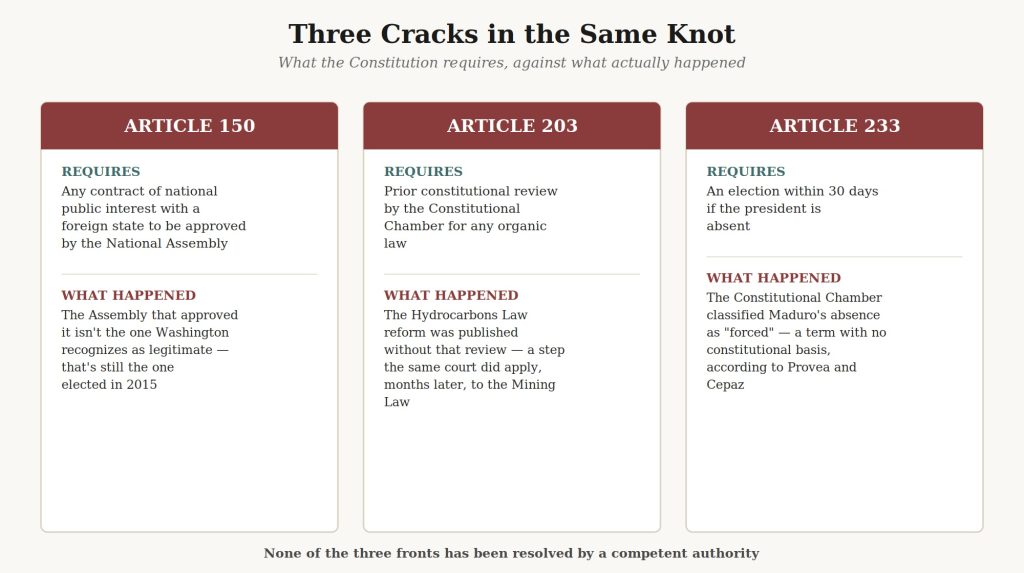
Article 150
Requires that any contract of national public interest with a foreign state be approved by the National Assembly. The one governing alongside Delcy Rodríguez since January is not the one Washington recognizes as legitimate — that’s still the one elected in 2015.
Article 203
The reform of the Hydrocarbons Law enabling much of this CPP reshuffling was published without the prior constitutional review Article 203 requires for organic-rank laws — a step the Constitutional Chamber did apply, months later, to the Mining Law, as we confirmed with the NGO Acceso a la Justicia.
The interim presidency and Article 233
To avoid the 30-day election trigger Article 233 requires, the Constitutional Chamber classified Maduro’s absence as “forced” — a term with no constitutional basis that Provea and Cepaz have called an invention. Former Supreme Court justice Blanca Rosa Mármol de León goes further: the deal is void, she says, signed by a usurper of the presidency.
None of these three fronts has been resolved by any competent authority. While they sit unresolved, the contracts keep piling up too, along with the operators betting the arrangement holds.
The Silence That Also Carries Weight
The people with the most political standing to question this deal’s legitimacy have, so far, chosen silence. Since the August 28 announcement, neither María Corina Machado — the opposition leader and 2025 Nobel Peace Prize laureate — nor her party, Vente Venezuela, have issued a statement. Neither has Edmundo González Urrutia, the candidate the opposition and much of the international community recognize as the actual winner of the 2024 election.
Two readings of the same silence
Other opposition sectors did speak up, demanding transparency. Consultant Ricardo Ríos calls Machado’s silence a tactical mistake: it “generates uncertainty among her base.” Political scientist Carmen Beatriz Fernández — CEO of DataStrategia and co-founder of the Latin American Association of Political Consultants (OCPLA) — reads it as deliberate calculation: “she wants to lead the agenda, not follow it.” Researcher Benigno Alarcón (UCAB) warns the deal, as structured, could delay the very transition the opposition says it’s pursuing.
Whatever the explanation, it isn’t a minor detail: the underlying constitutional objection ultimately depends on someone with political authority making that case publicly. So far, the people with the most weight to do so haven’t.
What Rubio did say
The contrast sharpened on September 1: Rubio did talk about Machado in that same interview with Novelli — he said that, as a Venezuelan citizen, she has every right to return to the country and that Washington “can’t stop her from traveling” — but on the oil deal itself, neither did he attribute a position to her, nor has she given one.
What’s at Stake
A precedent that doesn’t help
The Venezuela US SRL case — a dispute over $58.8 million in unpaid oil dividends dating to 2008 and 2009 — took more than a decade in arbitration and ended, this past June, with a U.S. appeals court upholding enforcement of an award of more than $108 million against the Venezuelan state. Petrodelta is already anticipating arbitration over its fields. The lesson is the same: contracts signed in a hurry, without bidding and without the backing of the Assembly Washington recognizes, can become liabilities that take years to resolve — or the dead letter we warned about in our first piece.
But it’s worth asking whether that threat really matters to the operators moving in now. The difference with Exxon is one of time horizon, not just size: Exxon needs firm legal ground because its investment must hold up for decades. NABEP, Pacific Coast, KEO and Ehrsam don’t depend on that durability — they get paid as soon as the crude is extracted and sold, via segregated accounts, with barrels Trump himself says are already reaching Texas and Louisiana “very profitably.” If the barrel is sold and paid for today, whether the contract holds up in ten years stops being their risk. The risk of future nullification isn’t theirs to bear — Venezuela inherits it.
The mechanism, plainly stated
Put simply, here’s how the deal works: a politically-connected operator secures, without competing, a field the state had already developed; lines up outside capital — debt, SPAC trust funds — to make it look viable; subcontracts the work that actually requires expertise to a service major; and gets paid as soon as the crude sells. It doesn’t need an oil track record — it needs access. The partners and investors behind each name collect while the field produces; the officials who made the assignment get a fresh production number to show Washington; and if a court later voids it all, the risk is inherited by the country that gave up the asset without bidding. It’s quick-harvest logic, not the logic of building a lasting industry.
What Does Venezuela Actually Get?
The collapse behind the numbers
It’s worth stepping back. Venezuela produced a historic 3.4 to 3.5 million barrels a day in 1998, on the eve of Chávez taking power. Twenty-seven years later, after PDVSA’s collapse and a fall to a low near 500,000 barrels a day in 2020, the country is barely holding at 1.1-1.2 million today — not even a third of that peak. In more than two and a half decades of the “Bolivarian revolution,” chavismo never built any meaningful capacity of its own to develop the resource that remains, on paper, the state’s inalienable patrimony.
Rent, not an industry of its own
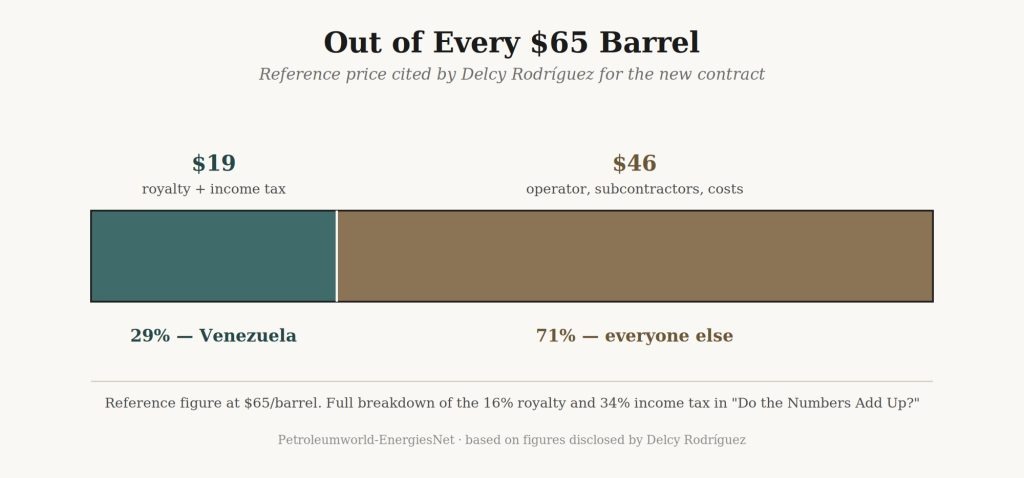
This deal formalizes that reality: Venezuela doesn’t operate, doesn’t invest, doesn’t bring its own technology — foreign operators do, subcontracting the real work as we’ve seen. What the state gets in return is, essentially, rent: a 16% minimum royalty, a 34% income tax, and — per figures Delcy Rodríguez herself disclosed — roughly $19 per barrel produced and sold at a $65 reference price. We broke those figures down, including a math error involving the promised $209 billion, in “Do the Numbers Add Up?”
It’s essentially a return to the model that predated the 1976 nationalization: the state owns the subsoil and gets paid for it, but isn’t the one producing. The additional barrels don’t strengthen an industry Venezuela can run itself — they arrive, as Trump has said, “very profitably” at refineries in Texas and Louisiana. The one gaining more barrels on the market is the United States; what Venezuela gains is a slice of the rent.
A legitimacy that doesn’t expire
That rent rests, in turn, on a legitimacy that doesn’t expire. This arrangement was made without the backing of a democratically elected Assembly — the constitutional knot already explained — leaving it exposed to challenge in court, whether Venezuelan, American, or international arbitration, as soon as today’s political circumstances change. Trump won’t always be in the White House; if Venezuela recovers full democracy, nothing guarantees a legitimately elected Assembly will validate contracts signed without its approval.
Stepping off the plane in Caracas, Wright put it in different terms: “These investment deals in Venezuela are… to bring peace, opportunity and prosperity to the people of Venezuela and to the people of the United States.” The distance between that phrase and what these pages actually describe — fields assigned without bidding, technical work subcontracted out, borrowed capital, immediate payouts, and legal risk inherited by Venezuela — may be the best measure of how well this deal holds up against the facts.
By Elio Ohep, editor of petroleuworld.com
EnergiesNet.com 09 02 206