Between a 16% royalty, a 55% U.S. equity stake, and an arithmetic error already circulating online, here’s what the official figures on the Venezuela deal say — and don’t yet say.
By Elio Ohep, Petroleumworld-EnergiesNet
SAN DIEGO, CA
Petroleumworld.com/EnergiesNet.com 09 01 2026
Since Donald Trump announced the oil deal on August 28, a handful of numbers — 55%, 16%, 30%, $19 a barrel, 100 years, 25 years — have been circulating as if they were interchangeable. They aren’t. Days later the White House published a fact sheet with additional details, and Venezuela’s interim government has offered its own separately. Cross-referencing both sources makes it possible, for the first time, to explain where each number comes from — and why mixing them produces the wrong answer.
Royalty and Equity Are Not the Same Thing
They’re two different things, and they need to be kept apart.
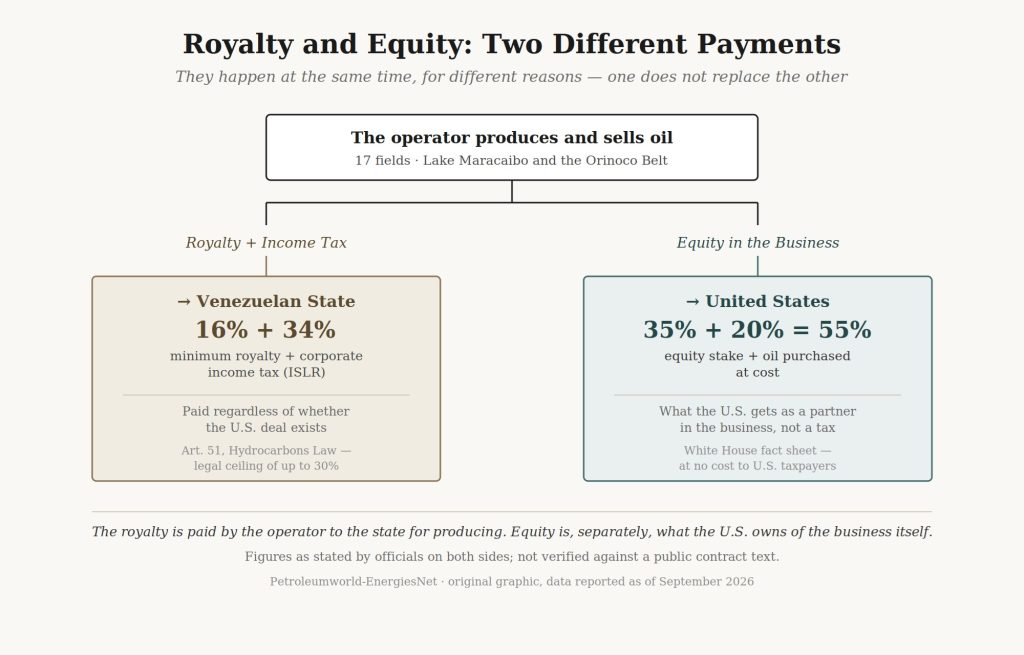
A royalty is what any oil company pays the Venezuelan state for extracting the resource — whether or not a deal with the United States exists. The 2026 reform of the Organic Hydrocarbons Law, passed by Venezuela’s National Assembly, sets in Article 51 “a royalty of up to 30%,” and empowers the Executive to set it project by project “considering investment, nature, profitability, and international competitiveness.” In other words, 30% is a legal ceiling, not a fixed or automatic rate.
For this specific deal, the government has given a more concrete figure, within that ceiling: a 16% minimum royalty, plus a 34% corporate income tax, calculated on profit after costs are deducted. It’s an improvement on the past: the government itself noted that the last time new fields were opened in Venezuela, thirty years ago, the royalty was just 1%.
Although those two figures (16% and 34%) come from the Venezuelan side, the United States hasn’t disputed them — not even in the official document the White House published with other deal details. If those numbers were wrong, it would be normal for Washington to correct them, as it has done on other points of the agreement. That it hasn’t is a sign in favor of their accuracy.
Equity is something else: it’s what the U.S. holds in the joint venture as a partner, not a tax paid to the Venezuelan state. According to the White House, Washington holds a 35% equity stake in the operator’s parent company — at no cost to U.S. taxpayers — plus the right to buy 20% of production at cost. Combined, those two pieces give the United States 55% of the value the business generates, the figure we reported in our earlier note.
In short: the operator pays royalties and taxes to the Venezuelan state for producing. Separately, and at the same time, the United States owns part of the business itself. They’re two different payments, to two different parties, for two different reasons.
The Case of the $19-a-Barrel Figure
This is the example that best explains where the confusion comes from. Step by step:
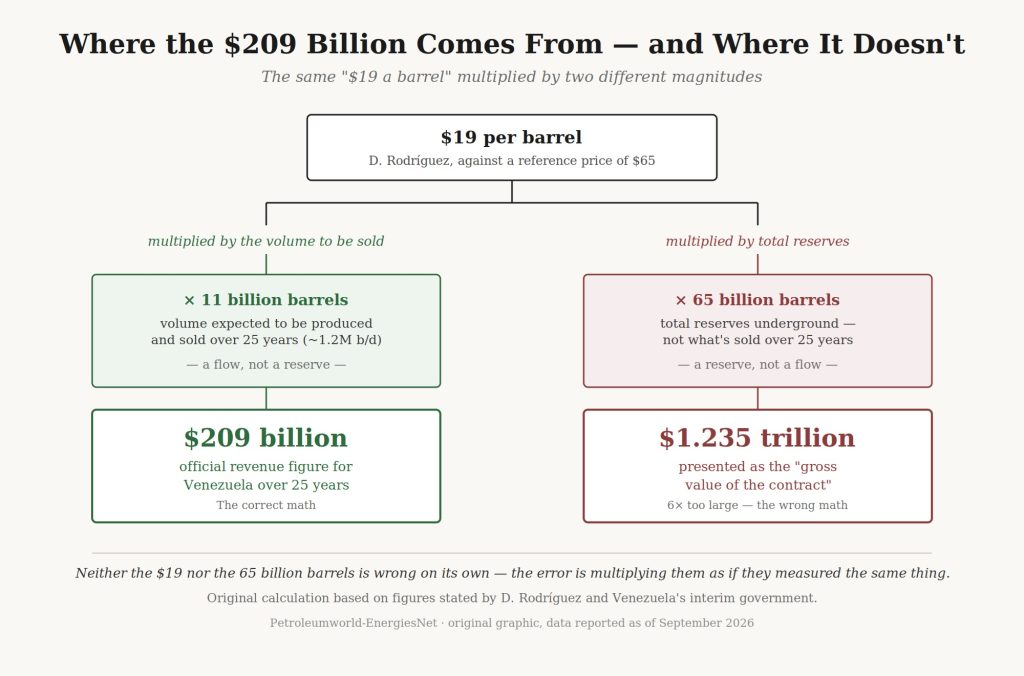
- D. Rodríguez said Venezuela receives roughly $19 for every barrel produced and sold, calculated against a reference price of $65 a barrel.
- On that basis, the government announced Venezuela would earn $209 billion over 25 years.
- Dividing $209 billion by $19 gives the number of barrels needed to reach that figure: 11 billion barrels over those 25 years.
- Spread across 25 years, that works out to an average of just over 1.2 million barrels a day — a realistic figure: slightly above what Venezuela produces today (between 1.0 and 1.1 million b/d) and below the government’s own target for these fields (more than 1.5 million b/d).
So far, the math holds together. The problem shows up when someone takes that same “$19 a barrel” and, instead of multiplying it by the 11 billion barrels expected to be sold, multiplies it by the 65 billion barrels of total reserves — that is, all the oil underground, not just what’s planned for extraction over 25 years. That calculation yields $1.235 trillion, a figure we’ve seen circulating as if it were “the value of the contract.” It’s six times larger than the real $209 billion.
Neither number is wrong on its own — not the $19, not the 65 billion barrels. The error is multiplying them together as if they measured the same thing. One measures how much oil sits underground; the other measures how much is expected to be sold over a given period. They’re two different questions.

100 Years, 25 Years: Two Different Timeframes
Another common source of confusion: the White House describes the concession as lasting 100 years. D. Rodríguez has spoken of 25 years. It’s not that the two contradict each other — they’re two different things. The 100-year figure is how long the right to operate the fields lasts. The 25-year figure is the window over which the projected $209 billion in earnings for Venezuela was calculated. The problem is that both numbers circulate loose, without that distinction, and end up sounding like the deal has two conflicting expiration dates.
Not an Exploration Bet
One clarification worth making about what kind of deal this actually is. Of the 17 fields, eight are “greenfield” blocks in the Orinoco Belt — with no prior infrastructure, requiring development from scratch — but the rest are already-mature fields in Lake Maracaibo that need reactivation and optimization, not exploration from zero. That changes the risk profile: this isn’t, for the most part, the kind of large-capital exploration bet that typically draws in the biggest oil majors. And yet, even with that reduced operational risk, ExxonMobil and ConocoPhillips still haven’t committed new capital. That points to the heavier risk not being operational, but legal.
The Legal Knot at the Core
There’s a question none of these figures answer, and it explains why big capital is still staying out even though the business itself is less risky than it looks: does this hold up over time? Article 150 of Venezuela’s Constitution requires that a contract of national public interest with a foreign state be approved by the National Assembly. The problem is which Assembly. The one governing alongside D. Rodríguez — installed in January 2026, with a PSUV majority, presided over by Jorge Rodríguez, her brother — is not the one Washington recognizes as Venezuela’s legitimate legislative body. That’s still, as the State Department reaffirmed as recently as June of this year, the National Assembly elected in 2015.
That explains why Washington’s pressure hasn’t been limited to asking for the deal to be signed, but has extended to demanding a broader restructuring of Venezuela’s public powers — legislative, judicial, electoral — not simply the installation of any assembly. Until that renewal happens, formal approval of the contract by the Assembly D. Rodríguez currently governs alongside wouldn’t settle the underlying question already raised by Hausmann and Coronel about her authority to sign the pact in the first place: it would be the same power approving its own contract, not an independent check. And that, ultimately, is why neither ExxonMobil nor ConocoPhillips are risking capital yet: the business may carry low operational risk, but without that check, it remains high legal risk. Without that renewal, as we noted in our earlier piece, everything else — the figures, the percentages, the projections — remains a dead letter.
What’s Still Missing
All of these figures — 16%, 55%, $19, 100 years, 25 years — come from what officials on both sides have said publicly. No one has yet produced the text of the contract. That doesn’t make them false: in the case of the royalty, as we saw, Washington’s silence works in its favor. But it does explain why it’s so easy for real numbers to get mixed in ways that aren’t. Until there’s a public document, cross-referencing what each side says — and checking, figure by figure, where each one comes from — remains the only way to get closer to the truth.
Related coverage (in Spanish): Letra muerta: el acuerdo petrolero de Trump y Venezuela · ¿Las Cuentas Cuadran?
Sources: Fact Sheet — The White House, NPR, La Patilla, Bitácora Económica, RNV, Venezuela’s National Assembly — Hydrocarbons Law reform, Infobae — U.S. recognition of the 2015 Assembly, El Nacional — Washington’s dilemma, MINCYT — installation of the 2026-2031 Assembly, El Nacional — fields and wells involved, Claude (Anthropic AI) —research assistance.
By Elio Ohep, editor@petroleumworld.com
EnergiesNet.com 09 01 2026