What’s actually being negotiated is a lease, not a takeover — and it only works if Big Oil believes Venezuela’s courts and institutions will hold up this time, through the democratic changes now underway.
By Elio Ohep, Petroleumworld-EnergiesNet
SAN DIEGO, CA
Petroleumworld.com/EnergiesNet.com 08 28 2026
On August 27, Axios reported big news. It said the Trump administration was “close to striking” a “massive” deal for Venezuelan oil fields. One official called it an “ownership stake.”
The story spread fast. U.S. news sites picked it up right away. Bloomberg translated it into Spanish. It ran across Latin American media within a day.
Reuters had a different version. Marianna Párraga and Jarrett Renshaw reported it. Both have covered Venezuelan oil for years.
Their version was more precise. It wasn’t U.S. ownership. It was American companies getting long-term access to a group of oilfields. The tool for that is a lease. Companies would bid for the right to work specific fields.
That difference matters. But it’s not the main story.
The bigger question is this: what would it actually take for big oil companies to trust Venezuela enough to put real money in again?
What Reuters actually found
Here’s what we know for sure. Talks are happening at a high level. Secretary of State Marco Rubio is leading them for the U.S. Interim president D. Rodríguez is leading them for Venezuela.
The plan is a lease, not ownership. A group of oilfields would go to U.S. companies. They’d get them through some kind of bidding process.
Reuters flagged something important. Axios left it out. Under Venezuela’s current laws, this kind of deal could hit constitutional problems. The country’s oil law hasn’t normally allowed this type of lease. The constitution says the state controls the core of the oil industry.
That’s the real thread to follow. This isn’t a simple, one-time deal. It only works if Venezuela’s legal system can actually back it up.
What a “lease” actually means here
This part matters, because “lease” and “ownership stake” sound similar but aren’t. Here’s the real difference.
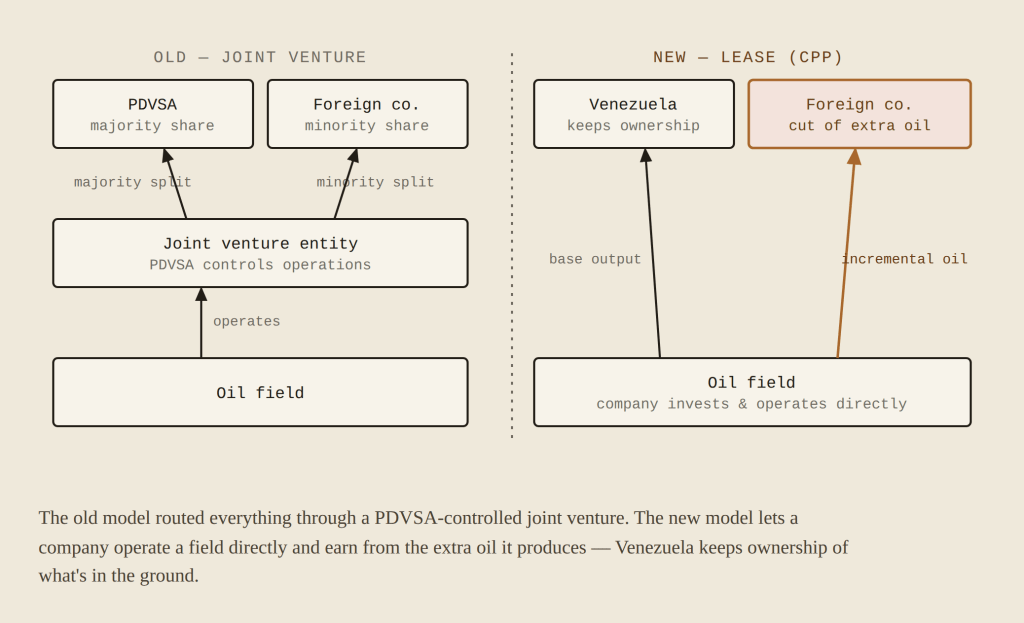
For decades, Venezuela only let foreign oil companies in one way: a joint venture with PDVSA, the state oil company. By law, PDVSA had to hold at least 60% of any such venture. It controlled the operation. Foreign partners were junior partners, along for the ride.
In January of this year, Venezuela changed that. A new law created something called a Production Participation Contract, or CPP. Under a CPP, a foreign company can run a field directly. No PDVSA joint venture required.
Here’s the trade. The company pays to fix up and expand the field — new wells, new equipment, whatever it takes. In return, it gets a cut of the extra oil that comes out because of that work. Venezuela still owns the oil in the ground. The company gets paid from what it helps produce, not by owning a piece of Venezuela’s reserves.
That’s already happening on a small scale. In August, Hunt Oil signed exactly this kind of deal for two fields in eastern Venezuela. Hunt covers the costs. Hunt gets a share of what those fields produce.
The bigger deal Axios and Reuters both reported looks like this same model, scaled way up: a group of fields, opened to bidding, with U.S. companies competing for the right to invest in them and take a cut of the oil that comes out. That’s a lease in the practical sense — the right to work the land and earn from it for a period of time. It is not the U.S. government owning Venezuelan oil.
The real problem isn’t the deal. It’s trust.
Venezuela has never been short on oil. For twenty years, it’s been short on something else: investors who believe a deal signed today will still hold up tomorrow.
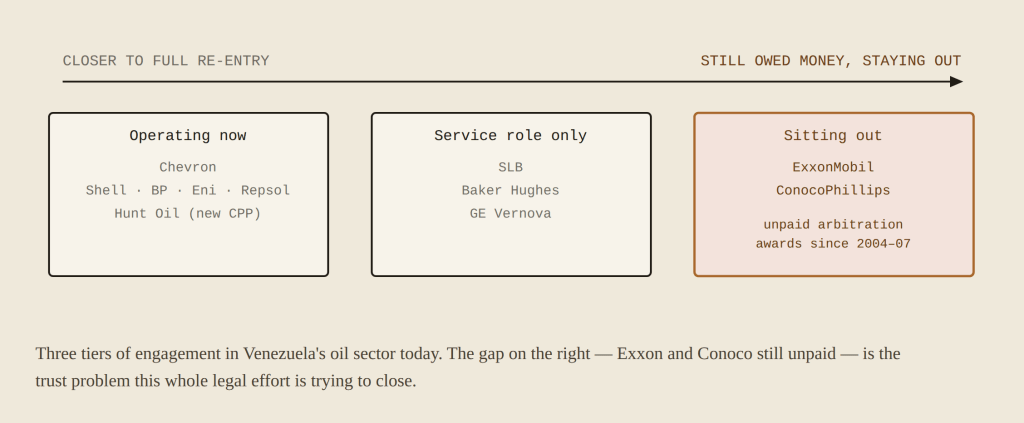
Right now, Chevron is the only major oil company really working there. Even Chevron hasn’t committed to expanding. ExxonMobil and ConocoPhillips are still staying out. (We mapped exactly who’s active in Venezuela’s energy sector right now, and on what terms, in an earlier piece: The Price of Admission.)
Both companies are still owed money. It goes back to 2004–2007. Venezuela’s government rewrote their contracts back then. It took over their stakes. It never fully paid what courts later said it owed.
The companies themselves have said as much, plainly. ExxonMobil’s CEO, Darren Woods, has called Venezuela’s oil sector “uninvestable” without real changes to the legal and commercial rules. ConocoPhillips CEO Ryan Lance has said PDVSA needs to be restructured, and its old debts resolved, before his company commits further.
Francisco Monaldi, an energy scholar at Rice University’s Baker Institute who has studied Venezuela’s oil sector for decades, puts it simply: “The real obstacles to investment are not found below ground but above it. They are political, regulatory, and institutional in nature.”
That history is the real obstacle. A new fields deal doesn’t erase it. What might actually fix it is a legal and political system investors can believe in — one that shows Venezuela won’t do this again.
What’s being done to reduce the legal risk
This is where the real work is happening. It’s bigger than any single oil deal.
On the U.S. side. Washington has been making Venezuelan oil business legal again, one company at a time. It does this through specific Treasury approvals.
These approvals come with rules. Contracts must use U.S. law. Disputes must go to U.S. courts. Payments must go through accounts the U.S. Treasury controls — not straight to the Venezuelan government.
The goal is simple. Keep American companies safe from sanctions trouble. Make sure any dispute gets settled in a U.S. court, not a Venezuelan one.
There’s a bigger reason this matters, too. In 2007, when Venezuela rewrote Exxon’s and Conoco’s contracts, it was really just picking a fight with two private companies. This time is different. By building the deal through U.S. sanctions law, U.S. courts, and U.S. Treasury payment channels, Washington is wiring itself directly into the arrangement.
That raises the cost of reneging. A future Venezuelan government thinking about tearing up these contracts wouldn’t just be crossing Chevron or Hunt Oil. It would be crossing the U.S. government that licensed the deal in the first place. That doesn’t make a repeat of 2007 impossible. But it makes it a lot less likely — and that’s very much the point.
Not everyone agrees this side of the scaffolding is as solid as it sounds, though. Earlier this year, a group of House Democrats warned major oil companies that the administration may not have clear constitutional authority to control Venezuelan assets this way, and that a future Congress, a future U.S. administration, or a future Venezuelan government could challenge these arrangements as invalid. Their letter included a pointed warning: “informal assurances” from the current administration “might not be recognized by future U.S. administrations.” That’s worth remembering — the U.S. side of this legal structure isn’t as fixed and permanent as it might sound.
On the Venezuelan side. The same January law that created the CPP model also gave foreign companies a new right: they can take contract disputes to international arbitration. They no longer have to rely only on Venezuelan courts.
Later rules added more protection. They’re called “economic-equilibrium” protections. They’re meant to hold up even if conditions change. The goal is to stop a repeat of what happened to Exxon and Conoco.
The biggest piece, though, is political. A lease is only as good as the government and courts standing behind it. And right now, Venezuela’s government doesn’t have full democratic legitimacy.
D. Rodríguez is an interim president, not an elected one. Anything she agrees to sits on shaky ground. A future, elected government could challenge it. A court could challenge it. Without real democracy behind it, a deal signed today may not hold.
Ricardo Hausmann, the Harvard economist who has written extensively about Venezuela’s economy, makes exactly this argument. Without credible institutions and political legitimacy, he says, Venezuela “cannot attract the private capital needed to rebuild its oil sector or provide the legal certainty long-term projects demand.” His point is about order. Legitimacy is what creates investor trust — not something that shows up automatically once the oil money starts moving.
This is exactly why Rubio is pushing so hard to finish Venezuela’s political rebuild — not just the oil talks. Trump’s team knows a deal with D. Rodríguez alone won’t be enough. It needs real institutions behind it to actually stick.
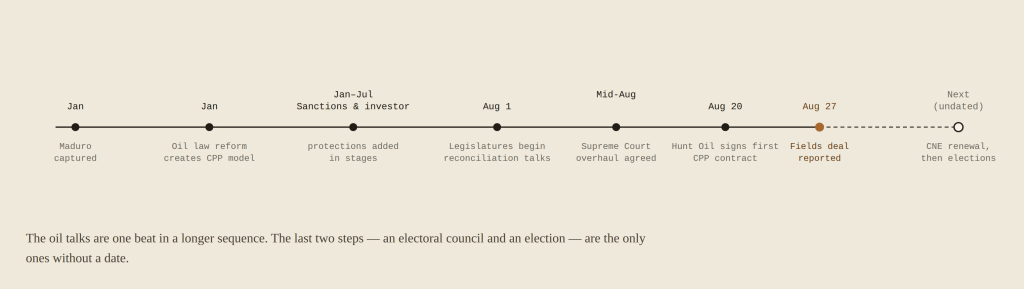
Since the U.S. captured Nicolás Maduro in January, Venezuela has had two rival legislatures. Each claims to be the real one. One is the opposition-led National Assembly, elected back in 2015. The other is a government-controlled Assembly, seated in 2026.
U.S.-backed talks between the two started in August. By mid-month, they’d already reached a deal to overhaul Venezuela’s Supreme Court. That means changing how judges get chosen. It means expanding the court, too.
Renewing the National Electoral Council is expected next. Elections are supposed to follow after that. But neither Washington nor Caracas has set a firm date.
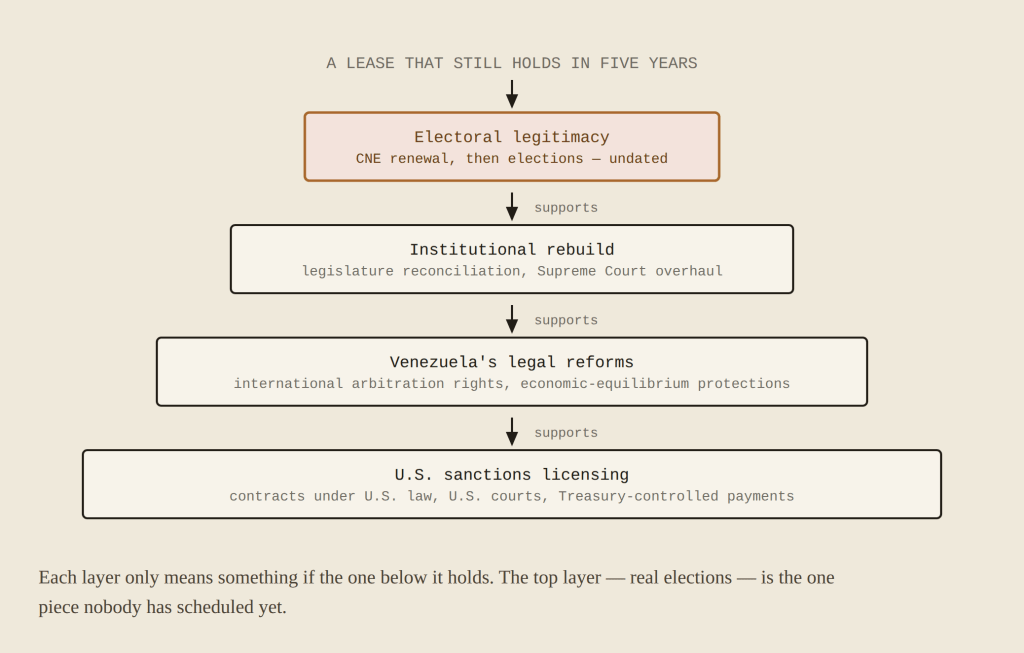
This political work isn’t separate from the oil story. It’s the actual mechanism that would let a lease signed today still mean something in five years. That takes a legislature both sides accept as legitimate. It takes a court system with new judges nobody can call rigged. Eventually, it takes real elections — so whoever signs the next set of oil contracts has a mandate nobody can easily challenge.
Investors aren’t just weighing the fields deal itself. They’re weighing whether Venezuela’s institutions will still honor it once power changes hands again.
Why the U.S. is pushing this now
The administration gives a few reasons. The U.S. Strategic Petroleum Reserve is at a 40-year low. The wars in Iran and Ukraine have disrupted global oil supply. Gas prices are a worry ahead of the midterm elections. And this is a chance to take over oil fields that used to involve Chinese interests.
Trump has also tied this to something bigger. He calls it the “Donroe Doctrine.” The idea is reasserting U.S. influence across the whole Western Hemisphere.
Not everyone who studies energy agrees this makes sense, though. Some analysts doubt the U.S. really needs this much control over oil supply. Some doubt Venezuelan oil would even bring gas prices down much. Global oil markets don’t always work that simply.
That doesn’t mean the effort isn’t real. It clearly is. It just means the administration’s own explanation shouldn’t be taken completely at face value.
Hausmann has gone further than that. He’s argued that much of the wealth from Venezuela’s oil deals so far has gone to private dealmakers and politically connected insiders on both sides, rather than to ordinary Venezuelans. If he’s right, that’s a separate risk from everything else in this piece — not whether the legal system holds up, but who actually benefits when it does.
What to actually watch
Forget the next “close to a deal” headline. Those have been coming for months and don’t tell you much.
Watch the money instead. Are U.S. companies actually signing production contracts and spending on Venezuelan fields — like Hunt Oil just did — or is it still mostly talk? Monaldi’s own read is cautious: these new contracts “could open up a new wave of investment,” he told NPR. “Still, we have to wait and see if companies actually deploy their resources.”
Watch Exxon and Conoco specifically. The day they get paid what they’re owed, or agree to a real settlement, is the day you’ll know Venezuela is serious. Until then, their absence is the most honest signal in the whole story.
And watch the political calendar, not just the oil calendar: the courts, then the electoral council, then an actual election. That sequence is what turns a fragile deal into a durable one.
Because in the end, the oil was never the hard part. Venezuela has always had the oil. The hard part is whether anyone still trusts who’s selling it.
Sources
Axios, Reuters, Al Jazeera, S&P Global, Tech Times, Morgan Lewis, Fox News, MercoPress, Infobae, Council on Foreign Relations, Axios — Donroe Doctrine, EnergiesNet — The Price of Admission, EnergiesNet — Investor Guarantees, NPR, Project Syndicate — Hausmann, Feb, Project Syndicate — Hausmann, June, Rep. Sean Casten, Claude (Anthropic AI) — research assistance.
By Elio Ohep, editor@petroleumworld.com
EnergiesNet.com 08 28 2026